Samurai Name Generator
The main tool: twelve styles from classic samurai to gamer tags, with kanji, meanings and a personal name option.
Masterless samurai
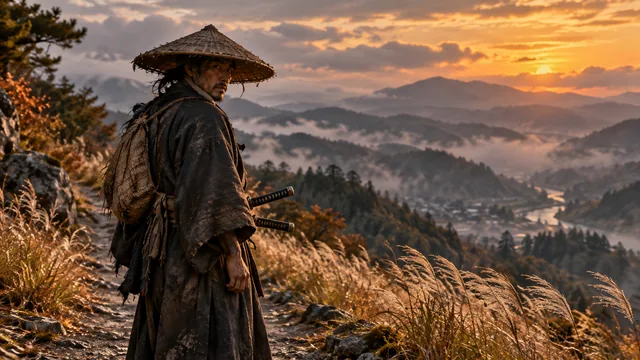
Name a samurai who has lost a lord, a stipend and a place in the world. Choose the path your character walks and get a grounded Japanese name with kanji and meanings, plus an optional road alias written for fiction.
Pick the road your character is on. The path shapes the epithet, the theme shapes the meaning of the name.
1Choose a path
2Tune your batch
Choose your options and press Generate Ronin Names to see your first batch.
Tap Save on any result to keep it here. Favorites stay on this device.
A samurai's income and status came from his lord. When that bond broke, through the lord's death or defeat, a confiscated domain, or dismissal, the samurai became a ronin. The early seventeenth century produced huge numbers of them after the Battle of Sekigahara and the Osaka campaigns.
Real ronin rarely lived like the lone swordsmen of film. Many became teachers, guards, clerks or farmers, and many looked for new service. The most famous ronin in history, the 47 retainers of Asano Naganori, waited almost two years before avenging their lord in 1703, and their story became the play Chushingura. That gap between the romantic image and the harder reality is exactly what makes ronin such good characters.
A ronin character can carry up to three layers of name, and the generator keeps them separate:
| Ending | Kanji | Origin | Example |
|---|---|---|---|
| -emon | 右衛門 / 左衛門 | Imperial gate guards of the right and left | Kichiemon 吉右衛門 |
| -bei | 兵衛 | Imperial palace guards | Hanbei 半兵衛 |
| -suke | 助 / 介 | "Assistant," a tier of court office | Kuranosuke 内蔵助 |
| -ro | 郎 | Son, often with a birth-order number | Sanjuro 三十郎 |
| -zo | 蔵 | "Storehouse," common in everyday names | Kyuzo 久蔵 |
The path is a character archetype, not a historical category. Real ronin were not sorted into types, and the generator does not pretend they were. The path only changes the creative epithet:
| Path | Who they are | Sample epithet |
|---|---|---|
| Wanderer | Drifts from town to town | of the Winter Road |
| Exile | Cast out, cannot go home | the Last of the House |
| Avenger | Lives for one unpaid debt | Who Keeps the Oath |
| Mercenary | Sells the sword for rice | of a Hundred Banners |
| Guardian | Protects those who cannot | the Watcher at the Bridge |
| Outlaw | Lives outside the law | the Black Wind |
| Stoic | Says little, waits long | Who Never Draws First |
Let the Japanese name hold the past and the epithet hold the present. A plain surname and a common name say "this man once had a place." The epithet says what the road has made of him. Kurosawa used this beautifully in Yojimbo, where the wandering samurai invents the name Kuwabatake Sanjuro, "mulberry field, thirty," by glancing at the view.
Accuracy note: every result is a fictional combination of real Japanese surnames and given names, written with standard kanji. A combination may match a real person by chance. Epithets are invented in English for storytelling and are not translations of historical titles.
For the full story of the 47 ronin and more ways to build a ronin name, read our guide to ronin names and masterless warriors.
FAQs
Ronin is usually written 浪人, "wave person," someone drifting like a wave. By the Edo period it meant a samurai with no lord and no stipend. Older sources also use the spelling 牢人 with the same reading.
No. English-style titles like these are a storytelling device, which is why the generator labels them as creative epithets. Real samurai sometimes earned nicknames, but they followed Japanese patterns, such as the Tiger of Kai for Takeda Shingen.
Edo period samurai usually went by a common name (tsusho) in daily life rather than their formal personal name. Endings such as -emon, -bei, -suke and -ro came from old court and guard offices and were extremely widespread, so they make a ronin sound lived-in. Oishi Kuranosuke of the 47 ronin is a famous example.
Historically, ronin were men of samurai households who had lost their lord. Fiction is free to imagine a wandering swordswoman, and the Female option gives her a Japanese name with kanji, but the card notes that this is a fictional choice.
A ronin usually came from a minor or broken house, not a great clan. The generator uses everyday landscape surnames such as Kitamura (north village) and Hayashi (grove), which sound like a real retainer rather than a famous lord.
Yes. Untick Add a creative epithet to get Japanese names only. You can also copy a name and write your own epithet, which is often the best way to fit it to your character's history.
More tools
Give your ronin a former clan, a blade, or rivals from other walks of life.
The main tool: twelve styles from classic samurai to gamer tags, with kanji, meanings and a personal name option.
Pick a role, from samurai and daimyo to warrior monk and foot soldier, and get a name that fits it.
House names for families and factions, with real historical clans clearly separated from fictional ones.
Names for katana and other blades, built on real patterns such as -maru and -kiri, with translations.
Keep reading
What the word ronin really means, how the 47 ronin of Ako were named, and a practical method for building a believable ronin name with a matching epithet.
The stories behind famous samurai nicknames like the Tiger of Kai and the One-Eyed Dragon, the patterns they follow, and how to write an epithet of your own.
A writer's guide to samurai character names: era, social rank, forms of address, name changes, women's names and the anachronisms that break immersion.