Female Samurai Names Inspired by the Onna-musha Warriors of Japan
Tomoe Gozen, Hangaku Gozen, Nakano Takeko and the names of women in warrior households, plus female samurai names with kanji and meanings.
Female samurai names draw on two traditions: the handful of women warriors, or onna-musha, whose names survive in chronicles and war tales, and the everyday names of women in samurai households, which were often short, natural and quietly elegant. This guide covers both, with kanji and meanings, so you can choose a name that feels grounded in real history.
Who Were the Onna-musha?
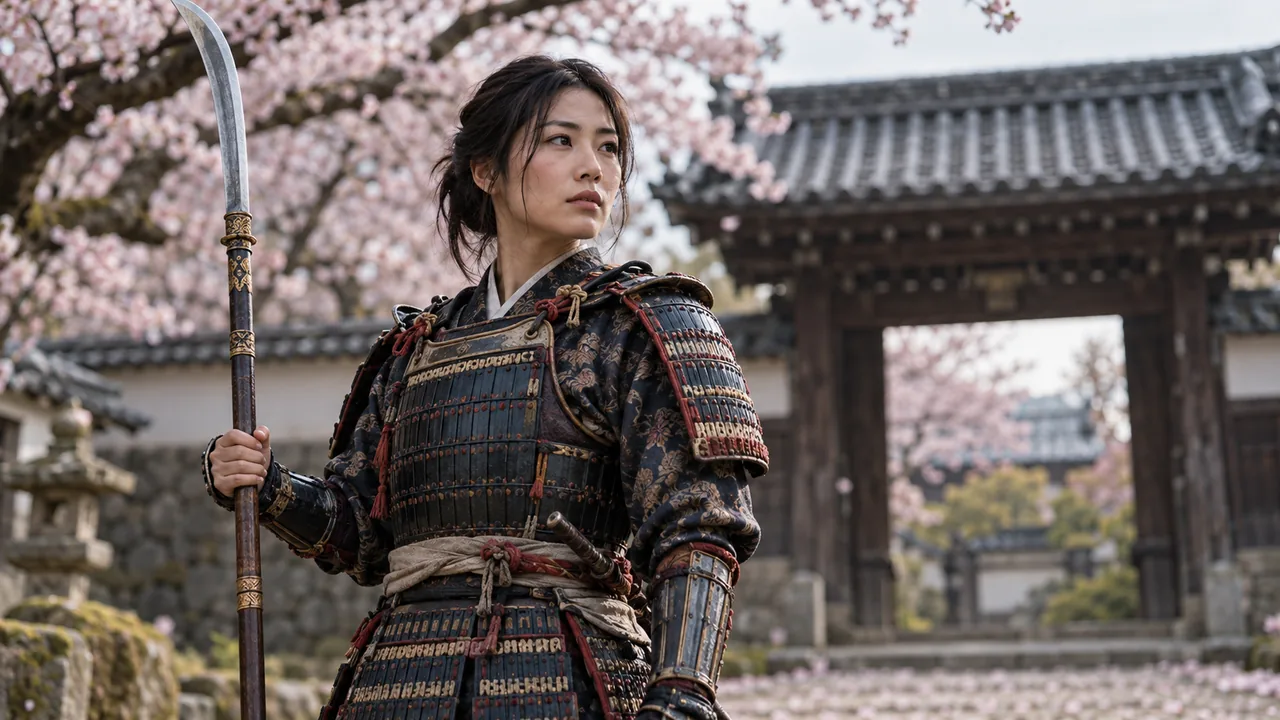
Onna-musha (女武者) is written with the characters for "woman" and "warrior." Women rarely fought in the front ranks of samurai armies, but they were far from absent from warfare. Women of warrior families were expected to defend the household when men were away, and from the Edo period onward many daughters of samurai trained with the naginata (薙刀), a curved blade on a long pole whose name literally means "mowing sword." Sieges in particular drew women into combat, as defenders of castles and homes.
The naginata became so closely tied to women of the warrior class that it is still practiced today as a martial art with many female students. Women of samurai families also commonly carried a kaiken (懐剣), a short dagger whose name means "bosom sword," kept in the folds of the kimono for self-defense. Neither weapon made a woman a battlefield warrior, but both reflect an expectation that she could protect herself and her household. That expectation matters when you name a character: a woman of a samurai house does not need to be a famous fighter for a strong, martial edge to suit her.
You will also see the term onna-bugeisha, "woman martial artist," which is widely used in modern books and online. Either way, the women below are the ones whose names have carried furthest.
Tomoe Gozen
Tomoe Gozen (巴御前) is the most famous woman warrior in Japanese literature. In The Tale of the Heike, she rides with Minamoto no Yoshinaka, also known as Kiso Yoshinaka, during the Genpei War of the 1180s. The tale describes her as beautiful, a superb archer and rider, and a match for a thousand ordinary warriors. In its account of Yoshinaka's last battle at Awazu in 1184, he orders her to leave the field, and she fights one final encounter before riding away.
Tomoe (巴) is the name of a comma-shaped swirl design, familiar from the three-part mitsudomoe pattern seen on drums, roof tiles and family crests. Gozen (御前) is an honorific for a woman of standing, roughly "lady," built from characters meaning "honorable" and "before," as in being in someone's presence. It is a title, not part of her personal name.
Because Tomoe appears mainly in war tales rather than official records, historians treat the details of her life with caution. Her later years exist only in legend. As a name, though, Tomoe is a strong, unusual choice with real history behind it.
Hangaku Gozen
Hangaku Gozen (板額御前, sometimes also written 坂額御前) belonged to the Jo family of Echigo Province. In 1201 her family rose against the Kamakura shogunate, and she helped defend their stronghold, fighting as an archer. According to the Azuma Kagami, the shogunate's own chronicle, she was wounded, captured and taken to Kamakura, where a retainer of the shogunate asked permission to marry her.
Unlike Tomoe, Hangaku appears in a historical chronicle, which makes her one of the better documented women warriors of medieval Japan. The origin of the name itself is not clear, so it is best used as a tribute to her rather than for the meaning of its characters.
Nakano Takeko and the Women of Aizu
Nakano Takeko (中野竹子) lived much later, at the very end of the samurai age. She was the daughter of a retainer of the Aizu domain, educated in literature and trained in the naginata. During the Boshin War in 1868, when imperial forces attacked Aizu, she fought with a group of women armed with naginata, later remembered as the Joshitai, or women's unit. She was shot and killed in the fighting, in her early twenties. Her given name, Takeko, combines 竹 (bamboo) and 子 (child).
Another Aizu woman, Yamamoto Yae (山本八重), fought during the same siege of Aizu's castle with a rifle rather than a blade. She later became known as Niijima Yae after marrying Niijima Jo, the founder of Doshisha in Kyoto. Yae means "eightfold," a word used for layered, many-petaled blossoms.
A woman at the head of a house
Ii Naotora (井伊直虎) is a different kind of figure. In the Sengoku period she led the Ii family of Totomi Province at a time when its male heirs had died, and she helped raise the boy who became Ii Naomasa, one of Tokugawa Ieyasu's leading generals. Naotora, "straight" and "tiger," is a man's-style formal name; she is also known as Jiro Hoshi, a name pairing a male birth-order name with a word for a Buddhist priest. Some details of her life are still debated by historians, but her story shows how a woman could take on a role and a name normally reserved for men.
How Women in Samurai Families Were Named
Women's names in samurai households followed different habits from men's. A few patterns are worth knowing:
- Short, simple names. Many women had names of two syllables, often taken from plants or lucky words. Maeda Toshiie's wife was Matsu (pine), and Toyotomi Hideyoshi's wife is known as Nene.
- The polite prefix O-. Names were often spoken with an honorific O- in front. Oda Nobunaga's sister Oichi was, in effect, Ichi with the polite prefix.
- Hime for daughters of lords. The word hime (姫), "princess," followed the names of high-ranking daughters. Senhime (千姫), granddaughter of Tokugawa Ieyasu, survived the fall of Osaka Castle in 1615.
- The ending -ko. The suffix 子, "child," has a long history among aristocratic women, but it became widespread among ordinary families only in the modern era.
- Titles in place of names. Women were often referred to by a title, a residence or, after taking Buddhist vows, a religious name. As a result, the personal names of many important women are not recorded at all.
The honorifics above, from Gozen to hime, are explored further in our guide to samurai honorifics.
Female Samurai Names With Meanings
These names suit a woman of a warrior household. Most come from nature, which fits the period, and all use the standard meanings of their kanji.
| Name | Kanji | Meaning | Feel |
|---|---|---|---|
| Tomoe | 巴 | Comma-shaped swirl design | Bold, legendary |
| Chiyo | 千代 | "Thousand generations," a wish for long life | Classic, warm |
| Kiku | 菊 | Chrysanthemum | Noble, autumnal |
| Ume | 梅 | Plum blossom | Hardy, early spring |
| Tsubaki | 椿 | Camellia | Striking, dramatic |
| Kaede | 楓 | Maple | Graceful, autumn color |
| Shizuka | 静 | Quiet, calm | Composed, poised |
| Kaoru | 薫 | Fragrance | Refined, courtly |
| Chizuru | 千鶴 | "Thousand cranes" | Elegant, auspicious |
| Akane | 茜 | Madder, a deep red dye plant | Fiery, vivid |
| Aya | 綾 | Twill, patterned silk | Delicate, crafted |
| Rin | 凛 | Dignified, severe, cold | Sharp, modern |
| Fuji | 藤 | Wisteria | Graceful, aristocratic |
| Sayo | 小夜 | "Small" and "night," a poetic word for night | Soft, mysterious |
Shizuka also has a famous bearer: Shizuka Gozen, the dancer who was the companion of Minamoto no Yoshitsune and who, as the story goes, defied his brother Yoritomo by singing of her love for Yoshitsune before the shogun himself. Rin is more modern in feel and works better for contemporary or anime-style fiction than a strict historical setting.
Tip: For a historical character, a short nature name with the prefix O- in dialogue (O-Kiku, O-Ume) sounds natural. Save Gozen or hime for a woman of real rank, since using them casually suggests a status the character may not have.
Choosing a Female Samurai Name
Decide first whether you want to honor a real woman warrior, such as Tomoe or Takeko, or to create a believable woman of a samurai household. For the first, use the historical name with care and respect its story; our article on famous samurai names tells more of the stories behind well-known warriors. For the second, pick a short nature name, add a family name, and decide which honorific, if any, fits her rank. The Onna-musha style in our samurai name generator produces female names with kanji and meanings if you would like more options. For more control over style and honorifics, try the dedicated Female Samurai Name Generator. For the wider picture of fighters beyond the samurai class, see our guide to Japanese warrior names.
Frequently Asked Questions
What were female samurai called?
Women who fought are usually described as onna-musha, written with the characters for woman and warrior. The term onna-bugeisha, meaning a woman skilled in martial arts, is also common in modern writing. Women of samurai families were expected to be able to defend the household, often with the naginata.
Who was the most famous female samurai?
Tomoe Gozen is the best known, thanks to her vivid portrait in The Tale of the Heike, where she fights for Minamoto no Yoshinaka in the 1180s. Because she appears mainly in literary sources, historians are cautious about the details of her life.
Did Japanese women's names always end in -ko?
No. The ending -ko, meaning child, was used by aristocratic women for centuries, but it became widespread among ordinary families only in the modern era. Many women in earlier periods had short names such as Matsu or Ichi, often spoken with the polite prefix O-.

Written by the Samurai Names Editorial Team
We research samurai history, Japanese names and kanji, and check every name against standard dictionaries. Read our editorial policy or contact us with corrections.