Samurai Name Generator
The main tool: twelve styles from classic samurai to gamer tags, with kanji, meanings and a personal name option.
Women of warrior houses
Create names for women of the samurai world, from a quiet daughter of a retainer to a lord's heir or a battle-hardened onna-musha. Every result shows the kanji, the meaning and how to say it, with honorifics explained.
Choose a style, add a theme and generate. Each card explains any honorific it uses.
1Choose a style
2Tune your batch
Choose your options and press Generate Names to see your first batch.
Tap Save on any result to keep it here. Favorites stay on this device.
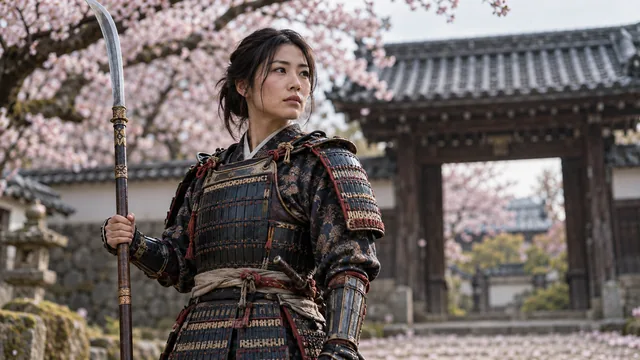
Women rarely fought in the front ranks of samurai armies, but they were not absent from warfare. They were expected to defend the household when men were away, and from the Edo period onward many daughters of samurai trained with the naginata, a curved blade on a long pole. Sieges in particular drew women into combat.
A few names have carried furthest. Tomoe Gozen rides with Minamoto no Yoshinaka in The Tale of the Heike, though historians treat the details of her life with caution because she appears mainly in war tales. Hangaku Gozen is recorded in the shogunate chronicle Azuma Kagami defending her family's stronghold in 1201. Nakano Takeko fought alongside a band of women armed with naginata at Aizu in 1868. Ii Naotora headed the Ii family in the Sengoku period under a man's-style name.
Women's names followed different habits from men's, and the generator's styles are built on them:
| Style | Example | Kanji | Meaning |
|---|---|---|---|
| Historical-inspired | Sanada Kiku | 真田菊 | true field, chrysanthemum; spoken O-Kiku |
| Onna-musha | Kuroda Tsubaki Gozen | 黒田椿御前 | black field, camellia, honored lady |
| Noble | Maeda Kaede-hime | 前田楓姫 | front field, maple, daughter of a lord |
| Noble | Chizuru no Kata | 千鶴の方 | thousand cranes, respected lady |
| Warrior | Mogami Takeko | 最上竹子 | uppermost, bamboo child |
| Fantasy | Shinonome Homura | 東雲焔 | daybreak clouds, flame |
These examples are fictional combinations. Surnames come from real warrior families or landscape names, so a result can share a family name with a historical house without describing anyone who lived.
Start with who she is. A woman of a retainer's household suits a short nature name and no title. A lord's daughter earns hime; a lord's wife, no Kata. Save Gozen for a woman of real standing, because it signals status. If she fights, let the meaning carry the edge: Tomoe, Rin (dignified) and Takeko (bamboo child, after Nakano Takeko) all sound strong without being invented.
Accuracy note: results are fictional combinations of real Japanese names and words with their standard kanji. They are inspired by how women of warrior families were named and do not describe real historical women. A few names, such as Tomoe, are famous because of a real or legendary figure; use them with that history in mind.
For the full stories of Tomoe Gozen, Hangaku Gozen and the women of Aizu, read our guide to female samurai names inspired by the onna-musha.
FAQs
Women of samurai families were expected to defend the household, and a few fought in battles and sieges. Tomoe Gozen appears in The Tale of the Heike, Hangaku Gozen in the shogunate chronicle Azuma Kagami, and Nakano Takeko fought at Aizu in 1868. They were exceptions, but they were real enough that the term onna-musha, "woman warrior," exists.
Onna-musha (女武者) means woman warrior and is the older term. Onna-bugeisha, "woman martial artist," is widely used in modern books and online. The generator uses onna-musha for the style name.
Gozen (御前) is an honorific for a woman of standing, as in Tomoe Gozen. Hime (姫) followed the names of daughters of high-ranking houses, as in Senhime. No Kata (の方) was a respectful way to refer to a lord's wife or consort. They are titles, not part of the personal name.
Short women's names were often spoken with the polite prefix O-, so Ichi became Oichi and Kiku became O-Kiku. The card shows that spoken form for two-syllable names so you can use it in dialogue.
The ending -ko (子, "child") was used by aristocratic women for centuries, but it became common among ordinary families only in the modern era. For a samurai-era character, a short nature name is usually the more natural choice.
Before the Meiji period a woman of a samurai family was commonly identified by the house she was born into, even after marriage. Hojo Masako, wife of Minamoto no Yoritomo, is the classic example. The generator follows that habit.
More tools
Name her house, her rivals and the blade she carries.
The main tool: twelve styles from classic samurai to gamer tags, with kanji, meanings and a personal name option.
Masterless samurai with Edo-style common names and optional creative epithets for seven story paths.
Pick a role, from samurai and daimyo to warrior monk and foot soldier, and get a name that fits it.
House names for families and factions, with real historical clans clearly separated from fictional ones.
Keep reading
Tomoe Gozen, Hangaku Gozen, Nakano Takeko and the names of women in warrior households, plus female samurai names with kanji and meanings.
What dono, sama, gozen and hime really meant in samurai Japan, why it is Minamoto no Yoritomo but never Tokugawa no Ieyasu, and how to use honorifics well.
Seven famous samurai names, from Minamoto no Yoshitsune to Saigo Takamori, and the surprising stories of how each warrior came to be known by them.