Naming Samurai Characters in Fiction: A Practical Guide for Writers
A writer's guide to samurai character names: era, social rank, forms of address, name changes, women's names and the anachronisms that break immersion.
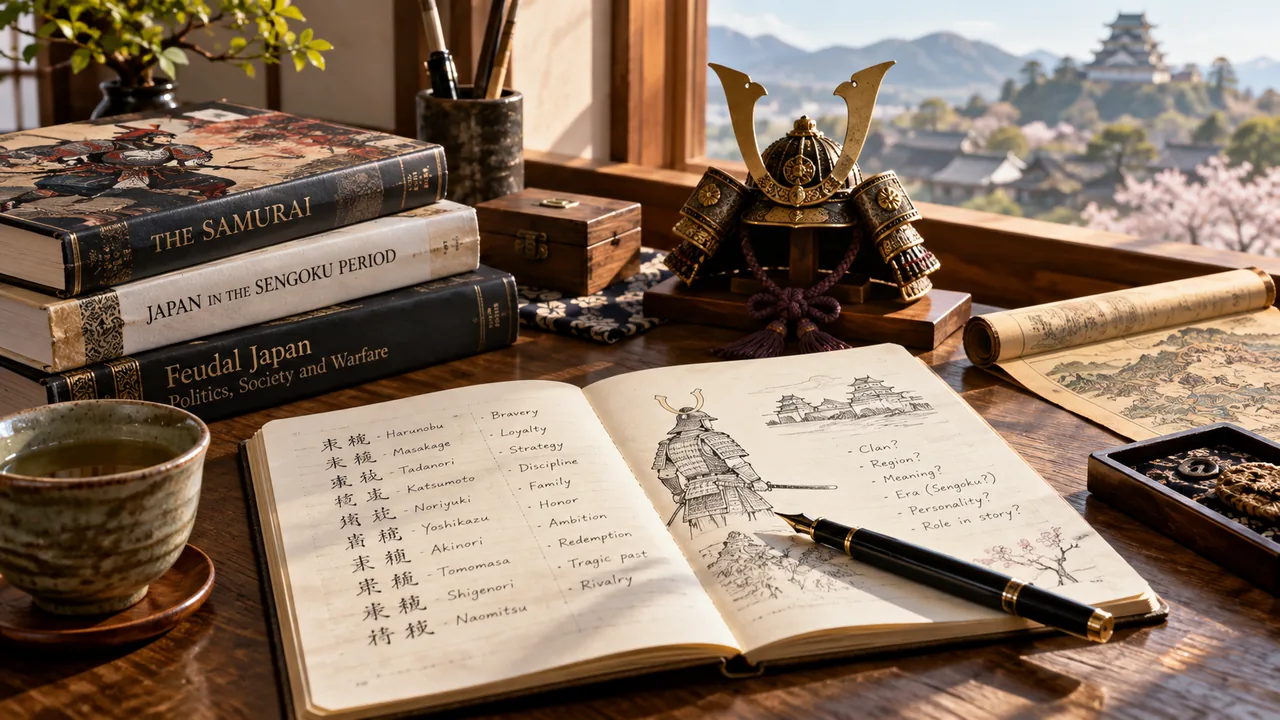
Good samurai character names fit three things at once: the era of your story, the character's social rank, and the way people around them would actually speak. Get those right and a name quietly does a lot of worldbuilding for you. Get them wrong and readers who know the period will stumble. This guide walks through the choices a writer has to make, from period accuracy to keeping a large cast readable.
Start With the Era
The samurai existed for roughly seven centuries, and naming habits changed over that time. Before you name anyone, pin down when your story takes place.
Heian and Genpei War (late 1100s)
Great warrior lineages used ancient clan names joined to the given name with no: Minamoto no Yoshitsune, Taira no Kiyomori. If your story is set in this world, that "no" form signals the period immediately. Our guide to samurai honorifics explains how the particle works and when it disappears.
Warring States (roughly 1467 to 1600)
By this time warriors were known by household surnames without the "no": Oda Nobunaga, Takeda Shingen, Uesugi Kenshin. Names changed often, lords handed out characters from their own names to followers, and many men are better known by a later Buddhist name than by their birth name.
Edo period (1603 to 1868)
Peace brought bureaucracy. Samurai were a hereditary class with fixed ranks, and common names built from old office titles, such as names ending in -zaemon or -bei, became extremely widespread. This is the world of retainers, castle towns and long, formal titles.
Bakumatsu (1850s and 1860s)
The final years of the shogunate feel closer to modern times, but the naming conventions are still Edo ones. Sakamoto Ryoma and the men of the Shinsengumi carried the same kinds of names as their grandfathers.
Match the Name to Social Rank
A name tells readers where a character stands. In the Edo period especially, rank shaped which names a man used and how he was addressed.
- Great lords were known by surname plus formal name in writing, but in daily life they were usually referred to by title or by the name of their domain. Many held honorary court titles in the form "X no Kami." Our post on samurai titles and ranks covers these in detail.
- Retainers typically had a surname, a common name used day to day, and a formal name reserved for documents. Kuroda Yoshitaka, for example, is widely remembered by his common name Kanbei.
- Foot soldiers and servants often appear in records with only a given name, frequently a simple common name.
- Farmers and townspeople in the Edo period could not officially use surnames in public, though many had them privately.
A useful rule: the more formal and multi-part a character's name, the higher their station. A foot soldier with a long, elaborate name will feel wrong, and so will a powerful lord who is only ever called by a nickname.
How Characters Address Each Other
This is where many stories slip. Samurai generally avoided calling a man by his formal given name (imina), which was considered too personal and potentially rude. Instead, people used one of the following:
- the common name (tsusho), such as Kanbei or Gonzaemon
- the surname, often with a term of respect such as dono
- an office or court title
- for a retainer speaking to his own lord, tono (殿), "my lord"
In practice, this means your lord character might be "Lord Kuroiwa" in narration and "Tono" in dialogue, while his formal given name appears only in letters, oaths and the narrator's introduction. Handling address this way adds authenticity with very little effort.
Tip: Make a short table for each major character listing their formal name, common name, title, and what each other character calls them. It prevents slips and makes social relationships visible on the page.
Name Changes Without Confusing Readers
Real samurai changed names several times: a childhood name, an adult name at the coming-of-age ceremony, sometimes a new name to honor a lord, and often a Buddhist name in later life. Tokugawa Ieyasu went through several before settling on the name history remembers. The full pattern is explained in our post on how samurai names actually worked.
In fiction, a name change can be a powerful moment, marking adulthood, a new allegiance or a fall from grace. Use it deliberately. A few habits help:
- Tie each name change to a scene readers can see, such as a coming-of-age ceremony.
- Have the narrator use one name per character within a section, even if other characters use different forms.
- Remind readers of the old name once or twice after the change, then let it go.
Two naming customs can also add depth. Families often shared a generation character: the later Hojo lords Ujitsuna, Ujiyasu, Ujimasa and Ujinao all carry 氏. Lords also granted characters from their own names, so Takeda Harunobu, later known as Shingen, received the 晴 in his name from the shogun Ashikaga Yoshiharu. Giving a retainer a character from his lord's name instantly shows their bond.
Naming Women Characters
Historical records often did not preserve women's personal names. Women of rank were frequently known by a title, a residence or their relationship to a man. Toyotomi Hideyoshi's wife Nene, for example, is often called by her title Kita no Mandokoro. Oda Nobunaga's sister is remembered as Oichi, with the honorific "no kata" sometimes added.
Daughters of lords might be called by a name plus hime, "princess," as with Senhime, the daughter of the second Tokugawa shogun. In the Edo period, women of ordinary families often had short names of two syllables, usually spoken with an honorific o- in front: O-Kiku, O-Ume. The ending -ko was used for aristocratic women in earlier periods and became common among ordinary women mainly in modern times, so it rarely suits a commoner in a Warring States story. Our post on female samurai names has more on warrior women and their names.
Avoiding Anachronism
Most naming errors in samurai fiction come from mixing periods or importing modern habits. Watch for these:
- Modern given names. Names that are popular with Japanese parents today often sound contemporary. A sixteenth-century retainer with a fashionable modern name feels like a time traveler.
- The wrong "no." "Oda no Nobunaga" is incorrect; the particle belongs with ancient clan names, not household surnames.
- Titles as names. Shogun, daimyo and ronin are positions, not names.
- Real clans as villains. Making a real family the bad guys can annoy readers who know the history. Invented landscape surnames are safer.
- Mixed languages. Chinese or Korean name patterns blended into Japanese names are a quick tell. Japanese syllables end in a vowel or "n."
Keeping a Large Cast Readable
Period accuracy does not have to cost clarity. Give major characters names with different first letters and different lengths, so readers can tell Kuroiwa from Matsuo at a glance. Avoid clusters like Takeshi, Takeo and Takehiro in the same cast unless they are meant to be brothers sharing a family character. Decide on romanization once: either use macrons for long vowels (Hōjō) or drop them (Hojo), and apply the choice throughout. A short glossary or cast list at the front of the book is common in historical fiction and very welcome.
Building Your Cast
Here is an invented example cast for an early Edo period story, showing how rank, era and address fit together. The names are combinations made for illustration, not historical people.
| Role | Name | Kanji | Notes |
|---|---|---|---|
| Lord | Kuroiwa Tadamasa | 黒岩忠正 | "Black rock"; formal name with "loyal" and "correct"; called Tono by retainers |
| Senior retainer | Ishiguro Gonzaemon | 石黒権左衛門 | Common name in the -zaemon style |
| Young samurai | Matsuo Shinjiro | 松尾新次郎 | "New second son"; birth order in the name |
| Lord's daughter | Tsuru-hime | 鶴姫 | "Crane princess" |
| Townswoman | O-Kiku | お菊 | Chrysanthemum, with the honorific o- |
If you need a fast list of options to choose from, our samurai name generator shows the kanji and meaning for each result, and entering your character's working name gives a repeatable result you can return to. Treat its output as raw material, then shape it with the era, rank and forms of address your story requires.
Frequently Asked Questions
Should I use Japanese name order in my novel?
For characters set in historical Japan, surname first is the standard and matches how historians write names such as Oda Nobunaga. Whatever you choose, introduce it early and apply it consistently, because switching order between chapters confuses readers.
How did samurai address each other?
Using a man's formal given name directly was generally avoided as impolite. People used his common name, his surname, an office or court title, or a term of respect such as dono, and retainers addressed their lord as tono.
Can I give a fictional samurai a real clan name?
You can, but readers will connect the character to that family's real history. For invented lords and villains, it is usually safer to build a new surname from ordinary landscape elements so you do not rewrite a real family's reputation by accident.

Written by the Samurai Names Editorial Team
We research samurai history, Japanese names and kanji, and check every name against standard dictionaries. Read our editorial policy or contact us with corrections.