Samurai Sword Names: Japan's Legendary Blades and How to Name a Katana
Japan's most famous named swords, from the Five Swords Under Heaven to Tonbogiri, and the naming patterns you can use to give your own katana a fitting name.
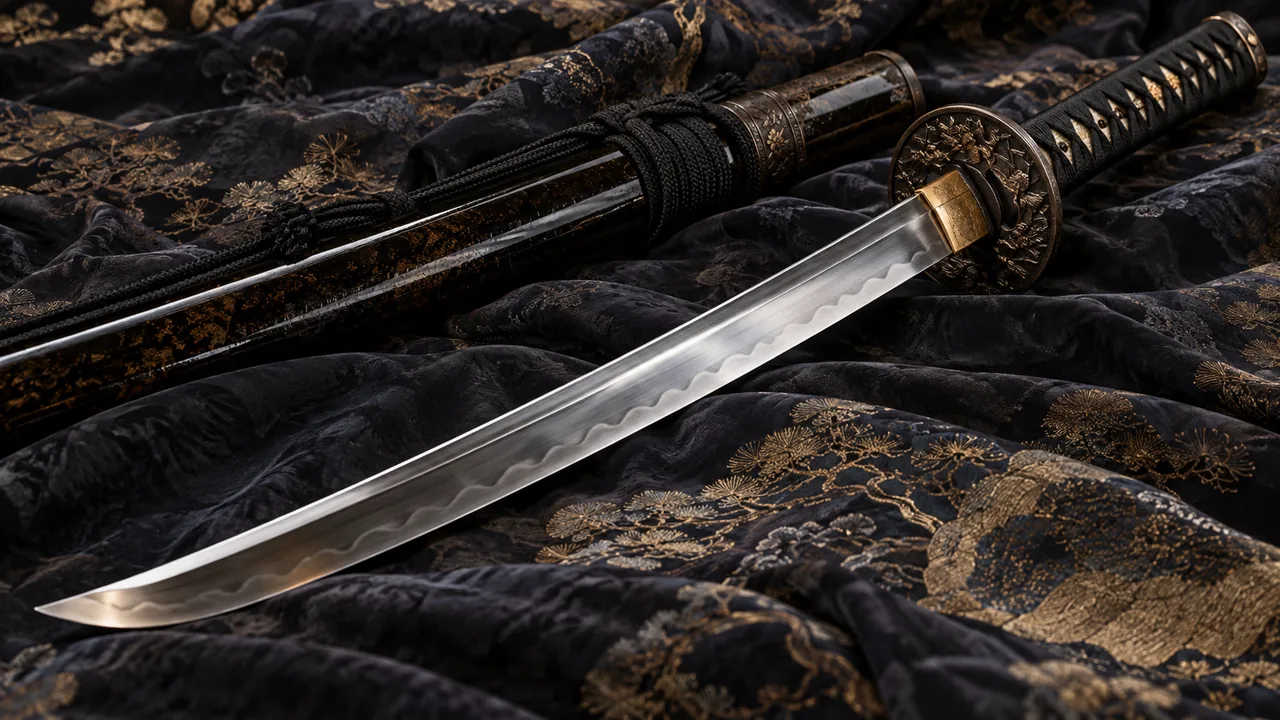
The most famous samurai sword names usually come from a legend, a striking feature of the blade, or something the sword was said to have cut. Japan's great named swords, like Dojikiri, Mikazuki and Heshikiri, follow a few clear patterns, and once you know them you can name a katana of your own that sounds like it belongs in a museum case rather than a video game menu.
How Japanese Swords Got Their Names
Two different kinds of "name" can be attached to a Japanese sword, and it helps to separate them.
- Mei (銘): the signature a smith chiseled into the tang, the part of the blade hidden inside the handle. It typically gives the smith's name and sometimes a date or place. Many swords are unsigned.
- Go (号): a nickname given to an individual sword, usually by owners, collectors or tradition. This is what people mean by a "named sword."
Famous swords are commonly referred to by combining the two. In Mikazuki Munechika, "Mikazuki" is the nickname and "Munechika" is the smith. Many such swords were treated as meibutsu (名物), "famous objects," and in the Kyoho era of the early eighteenth century the Hon'ami family of sword experts compiled a catalog of them for the shogunate.
The Tenka Goken: Five Swords Under Heaven
The best known group of named swords is the Tenka Goken (天下五剣), "the Five Swords Under Heaven." Each name tells you something about the sword's story.
| Sword | Kanji | What the name means | Story behind it |
|---|---|---|---|
| Dojikiri Yasutsuna | 童子切安綱 | "Doji cutter," by the smith Yasutsuna | Said to have been used by Minamoto no Yorimitsu to slay the demon Shuten-doji |
| Mikazuki Munechika | 三日月宗近 | "Crescent moon," by Sanjo Munechika | Named for crescent shaped patterns in the hardened edge |
| Onimaru Kunitsuna | 鬼丸国綱 | "Demon" + maru, by Awataguchi Kunitsuna | Legend says it freed Hojo Tokiyori from a demon that haunted his dreams |
| Odenta Mitsuyo | 大典太光世 | "Great Denta," from the smith Denta Mitsuyo | A treasured heirloom of the Maeda family of Kaga |
| Juzumaru Tsunetsugu | 数珠丸恒次 | "Prayer beads" + maru, by Aoe Tsunetsugu | Associated with the monk Nichiren, who is said to have hung prayer beads on its hilt |
Dojikiri and Mikazuki are both National Treasures held by the Tokyo National Museum, and Onimaru belongs to the imperial collection. Notice how the five names show the main naming methods in a single list: what the sword cut (Dojikiri), how it looks (Mikazuki), a creature from its legend (Onimaru), its maker (Odenta) and an object tied to its owner (Juzumaru).
Other Legendary Blades and Their Names
Kusanagi no Tsurugi
The oldest named sword in Japanese tradition is mythological. 草薙剣, Kusanagi no Tsurugi, is one of the three Imperial Regalia. Myth says the storm god Susanoo found it inside the tail of the eight-headed serpent Yamata no Orochi, and that the hero Yamato Takeru later used it to cut grass and escape a fire set by his enemies, which is how it got the name "grass cutter." It is traditionally enshrined at Atsuta Shrine in Nagoya and is never shown to the public.
Heshikiri Hasebe
圧切長谷部, Heshikiri Hasebe, was made by the smith Hasebe Kunishige. Tradition says Oda Nobunaga used it on a servant who had hidden under a cabinet, cutting him by pressing the blade down rather than swinging it, hence heshikiri, "pressing cut." It later passed to the Kuroda family and is now a National Treasure held by the Fukuoka City Museum.
Higekiri and Hizamaru
Two swords of the Minamoto clan appear together in medieval war tales: Higekiri (髭切), "beard cutter," and Hizamaru (膝丸), "knee" + maru. The legend says they were tested on condemned men, one cutting clean through to the beard and the other through to the knees. They are a good example of names that sound almost casual but carry a grim story.
Kogarasu-maru and Raikiri
小烏丸, Kogarasu-maru, "little crow," was an heirloom of the Taira clan and is now in the imperial collection. 雷切, Raikiri, "lightning cutter," belonged to the Kyushu general Tachibana Dosetsu. According to legend, he struck a bolt of lightning with his sword, which had been called Chidori, and renamed it Raikiri afterward.
Tonbogiri: a spear, not a sword
Honda Tadakatsu, one of Tokugawa Ieyasu's greatest generals, carried the spear 蜻蛉切, Tonbogiri. The story says a dragonfly landed on the blade and was sliced in two, and so the spear became the "dragonfly cutter." It is counted among the three great spears of Japan.
The Two Big Patterns: -maru and -kiri
-maru (丸)
Maru literally means "round" or "circle," but as a suffix it was attached to things that were cherished. Boys' childhood names (Ushiwakamaru, the young Minamoto no Yoshitsune), ships and swords all took it. A -maru name feels personal, almost like naming a companion: Onimaru, Juzumaru, Kogarasu-maru.
To build one, put a meaningful word in front: a creature, a natural image or an object. Two kanji in front plus maru is a comfortable length.
-kiri (切)
Kiri comes from the verb kiru, "to cut." A -kiri name records what the blade cut, whether real, legendary or impossible: a demon, a dragonfly, lightning. After some words the sound shifts to -giri, as in Tonbogiri. This sound change, called rendaku, does not happen in every compound, which is why both Dojikiri and Tonbogiri exist. Either way the kanji 切 stays the same; only the reading changes.
Tip: A -kiri name works best when the thing cut is surprising. "Iron cutter" is fine; "lightning cutter" or "moon cutter" tells a story in one word.
How to Name Your Own Katana
Here is a simple method that follows the historical patterns:
- Pick a source for the name. A legend (what did it cut?), a visual feature (a pattern in the steel), a creature, or an owner's object.
- Choose the pattern. Use -kiri for a deed and -maru for a cherished companion blade.
- Add a smith's name if you like. Real famous swords pair the nickname with the maker. A fictional smith's name in the style of Munechika or Kunitsuna adds weight.
- Check the kanji. Use common characters with clear meanings.
A few things to avoid: names that only make sense in English translation, long strings of three or four nouns, and borrowing a real famous name like Dojikiri or Raikiri for an unrelated blade. Each of those breaks the illusion that your sword has a history. A name should sound like something an owner or chronicler would actually have said, short enough to remember and specific enough to hint at a story. Some original examples built this way:
| Name | Kanji | Meaning | Pattern |
|---|---|---|---|
| Kazekiri | 風切 | "Wind cutter" | -kiri, a deed |
| Namikiri | 波切 | "Wave cutter" | -kiri, a deed |
| Tsukikiri | 月切 | "Moon cutter" | -kiri, an impossible deed |
| Yukimaru | 雪丸 | "Snow" + maru | -maru, natural image |
| Kagemaru | 影丸 | "Shadow" + maru | -maru, mood |
| Shirasagimaru | 白鷺丸 | "White heron" + maru | -maru, creature |
Our samurai name generator includes a Sword Names style that builds -maru and -kiri names automatically, with kanji and meanings, which is handy when you need several blades for a story or game. For blade types, themes and poetic or heroic styles, use the dedicated Samurai Sword Name Generator.
The Smiths Behind the Names
Sometimes the smith's name is the sword's fame. Masamune (正宗), who worked in Sagami province in the late Kamakura period, is regarded as one of the greatest swordsmiths in Japanese history. Muramasa (村正), a line of smiths from Ise province, became the subject of a later legend that his blades brought misfortune to the Tokugawa family. Both names now work almost like brand names for "a legendary blade," which is why fiction borrows them so often. Because they are real makers, it is better to treat them as references than to use them as a fictional sword's own name.
Choosing a Sword Name
The best samurai sword names are short, concrete and tied to a story. Decide what your blade did or what makes it special, pick -kiri or -maru accordingly, and keep the kanji simple. If the sword belongs to a character, let the name reflect that person's world: a monk's blade might take a Buddhist object, a northern lord's a winter image.
For more on the symbolism of characters like snow, moon and heron, read our guide to symbols in samurai names. If you also need a name for the warrior who carries the sword, our list of famous samurai names shows how real names were built.
Frequently Asked Questions
Did samurai really name their swords?
Many famous swords received names, called go, but usually from later owners, legends or collectors rather than from the warrior who first carried them. A name often recorded a story, such as what the sword was said to have cut. Most everyday swords were known only by the smith's signature, if they had one.
What does -maru mean in a sword name?
Maru (丸) literally means round or circle, but as a name suffix it was attached to things people valued, including boys' childhood names, ships and swords. A sword name like Kogarasu-maru, "little crow," uses it in this affectionate, possessive sense rather than to describe a shape.
What are the five most famous Japanese swords?
The traditional answer is the Tenka Goken, or Five Swords Under Heaven: Dojikiri Yasutsuna, Mikazuki Munechika, Onimaru Kunitsuna, Odenta Mitsuyo and Juzumaru Tsunetsugu. Each is named after a legend or feature and paired with the name of the smith who made it.

Written by the Samurai Names Editorial Team
We research samurai history, Japanese names and kanji, and check every name against standard dictionaries. Read our editorial policy or contact us with corrections.