Samurai Clan Names and the Families Behind Them
Minamoto, Taira, Hojo, Takeda, Tokugawa: what the great samurai clan names mean, where they came from, and why uji and myoji are not the same thing.
Samurai clan names come in two kinds. The oldest were ancient lineage names, or uji, such as Minamoto, Taira and Fujiwara. Most of the famous warrior houses, such as the Ashikaga, Takeda and Tokugawa, used myoji, family names usually taken from the place where a branch held land. Knowing the difference explains why one man could be both Minamoto no Ieyasu and Tokugawa Ieyasu.
Uji and Myoji: Two Kinds of Clan Name
An uji (氏) was a lineage name, inherited through descent and recognized by the imperial court. In formal use it is linked to the personal name by the particle no, meaning roughly "of": Minamoto no Yoritomo is Yoritomo of the Minamoto. Lineages could also hold a kabane (姓), a hereditary title such as ason that marked rank at court.
As families grew and branched, each branch needed a way to tell itself apart. They did it with a myoji (名字, also written 苗字), most often the name of their estate, village or district. A myoji is used without no, and like all Japanese names it comes before the personal name: Ashikaga Takauji, Takeda Shingen.
The two layers existed side by side. The Ashikaga were a branch of the Minamoto, so Ashikaga Takauji was formally a Minamoto. The Tokugawa claimed Minamoto descent too, and in court documents Ieyasu appears as Minamoto no Ieyasu. The myoji was the name of the house; the uji was the ancient lineage it claimed.
Clan names also behaved differently for women than they do in Japan today. A woman of a samurai family was commonly identified by the house she was born into, even after marriage. Hojo Masako is remembered by her own family's name rather than as a Minamoto, though she was the wife of Minamoto no Yoritomo, and Hino Tomiko, wife of the shogun Ashikaga Yoshimasa, is likewise known by her birth family. The modern rule that a married couple shares one surname dates from the Meiji period. If you are naming a married woman in a premodern setting, giving her the name of her birth family is the more accurate choice.
The Four Great Lineages
Four lineages were so prominent that they are often grouped together as Gen-Pei-To-Kitsu (源平藤橘), from one character of each name:
- Minamoto (源, "source, origin"): a name granted to members of the imperial family who were removed from the line of succession, beginning with sons of Emperor Saga in the early ninth century. The branch descended from Emperor Seiwa, the Seiwa Genji, produced the great warrior houses.
- Taira (平, "flat, level, peace"): another name given to former imperial princes, most famously the line descended from Emperor Kanmu. Under Taira no Kiyomori the Taira dominated the court until their defeat by the Minamoto in the Genpei War, which ended in 1185.
- Fujiwara (藤原, written with the characters for "wisteria" and "plain"): the name granted in 669 to Nakatomi no Kamatari. His descendants dominated the imperial court for centuries, and many later warrior families claimed descent from them.
- Tachibana (橘, a native Japanese citrus tree): an aristocratic lineage of the Nara and Heian periods.
Claims of descent from these lineages were extremely common among warrior families, and not all of them were genuine. A distinguished ancestry was useful politically, and genealogies were sometimes adjusted to provide one.
Famous Samurai Clan Names
Here are some of the best-known warrior house names. Most are place names, so the meanings below are the literal meanings of the characters, which describe the original place rather than the family.
| Clan | Kanji | Written with the characters for | Known for |
|---|---|---|---|
| Hojo | 北条 | "North" + "strip, line" | Regents of the Kamakura shogunate |
| Ashikaga | 足利 | "Foot" + "benefit" | Shoguns of the Muromachi period |
| Nitta | 新田 | "New" + "rice field" | Nitta Yoshisada, who took Kamakura in 1333 |
| Takeda | 武田 | "Martial" + "rice field" | Rulers of Kai Province |
| Uesugi | 上杉 | "Upper" + "cedar" | Kanto deputies, later lords of Echigo |
| Oda | 織田 | "Weave" + "rice field" | Oda Nobunaga, the first great unifier |
| Mori | 毛利 | "Hair" + "benefit" | Lords of western Honshu, later Choshu |
| Shimazu | 島津 | "Island" + "harbor" | Lords of Satsuma from the Kamakura period to Meiji |
| Date | 伊達 | A place name in Mutsu | Date Masamune and the Sendai domain |
| Hosokawa | 細川 | "Slender" + "river" | An Ashikaga branch, later lords of Kumamoto |
| Sanada | 真田 | "True" + "rice field" | A small Shinano house famed for its defenses |
| Tokugawa | 徳川 | "Virtue" + "river" | Shoguns from 1603 to 1867 |
For Date, the characters were chosen to write the sound of a place name, so their individual meanings say little. That is common with older place names and a good reason to be cautious about translating any surname too literally.
The Families Behind the Names
Two different Hojo
The Hojo of the Kamakura period were the family of Hojo Masako, wife of the first Kamakura shogun, Minamoto no Yoritomo. After his death they took control as regents and ruled in the shogun's name until 1333. Centuries later, a new house based at Odawara also took the name Hojo. Its founder is known as Hojo Soun, but he was born Ise Shinkuro, and the family adopted the Hojo name under his son Ujitsuna. Historians often call them the Later Hojo to avoid confusion. Their crest, three triangular scales, was also the crest of the Kamakura Hojo, which shows how deliberately they borrowed the older family's prestige.
Ashikaga and Nitta
Both families were Seiwa Genji, named after neighboring estates in the eastern provinces: Ashikaga in Shimotsuke and Nitta in Kozuke. In 1333 both turned against the Kamakura Hojo. They soon became rivals, and it was the Ashikaga who founded the next shogunate. The Tokugawa would later trace their own claimed Minamoto ancestry through the Nitta line.
Names that changed hands
A clan name could pass to a man who was not born to it. Uesugi Kenshin was born a Nagao and took the Uesugi name in 1561 when adopted by Uesugi Norimasa, along with the family's office. Tokugawa Ieyasu was born a Matsudaira and adopted the Tokugawa name in 1566. Toyotomi Hideyoshi went further. He was granted the entirely new name Toyotomi (豊臣, "abundant" and "minister") by the court in 1586, and it worked like an uji, an official lineage name, while his family name remained Hashiba. Our article on how samurai names worked follows these name changes in more detail.
Where Family Names Came From
Because most myoji came from land, they are full of landscape. A handful of characters appear again and again:
| Kanji | Reading | Meaning | Example |
|---|---|---|---|
| 田 | ta, da | Rice field | Takeda, Oda, Sanada |
| 川 | kawa, gawa | River | Tokugawa, Hosokawa, Imagawa |
| 山 | yama | Mountain | Yamana, Yamauchi |
| 島 | shima, jima | Island | Shimazu |
| 杉 | sugi | Japanese cedar | Uesugi |
Until the Meiji era, myoji were officially a privilege of the warrior class and certain other groups. Laws of 1870 and 1875 first allowed and then required all Japanese to register a surname, which is why so many ordinary modern surnames follow the same landscape patterns as samurai houses. Our guide to Japanese surnames that sound like samurai clans explores that side of the story.
Clan Names and Their Crests
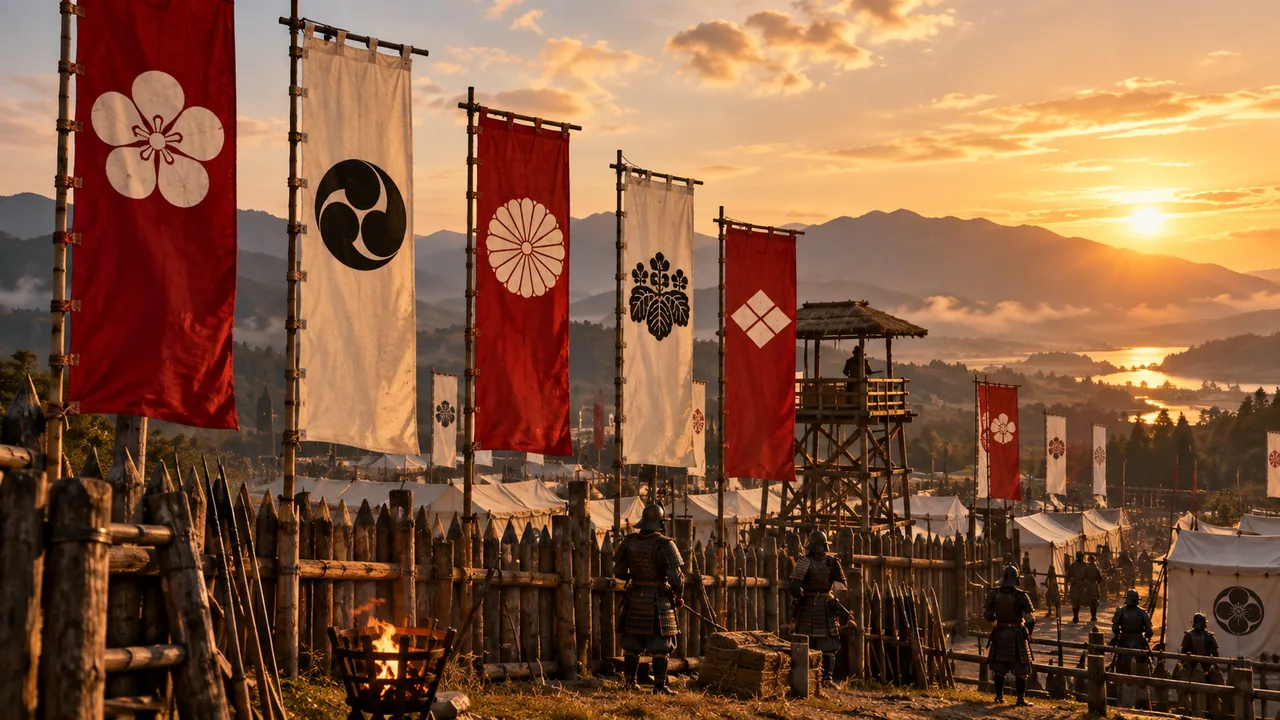
Every great house also had a kamon, a family crest displayed on banners, armor and clothing. A crest identified a family at a glance on the battlefield, so it often became as famous as the name.
| Clan | Crest |
|---|---|
| Hojo | Three scales arranged in a triangle |
| Takeda | Four diamonds, known as Takeda-bishi |
| Tokugawa | Three aoi leaves in a circle |
| Shimazu | A cross inside a circle |
| Sanada | Six coins, rokumonsen |
| Uesugi and Date | Variations of bamboo and sparrows |
Tip: If you are creating a fictional clan, design the name and the crest together. A family named for a river might bear waves or a water plant, and a house named for a cedar grove might bear a tree. The pairing makes the clan feel lived in. See our guide to samurai family crests for more ideas.
Choosing a Clan Name
For a real-world flavor, use one of the great houses, knowing it brings its history with it. For something original, combine one or two landscape characters in the same way real myoji were formed, and decide which ancient lineage your house claims, honestly or otherwise. The Clan House style in our samurai name generator pairs house names with a crest if you would like ready-made options to start from. To browse real historical clans and fictional ones side by side, each clearly labelled, use our Samurai Clan Name Generator.
Frequently Asked Questions
What is the difference between uji and myoji?
An uji was an ancient lineage name such as Minamoto, Taira or Fujiwara, used in court documents and written with no between the name and the person, as in Minamoto no Yoritomo. A myoji was a family name, usually taken from a place where the family held land, such as Ashikaga or Takeda, and it was used without no.
What were the most powerful samurai clans?
The Minamoto and Taira dominated the late twelfth century, the Hojo ruled as regents in the Kamakura period, and the Ashikaga and later the Tokugawa held the shogunate. In the Sengoku period, houses such as the Takeda, Uesugi, Oda, Mori, Shimazu and Date were among the strongest regional powers.
Can I use a real samurai clan name for my character?
Yes, but real names like Takeda or Tokugawa carry strong associations, and readers may assume a link to the historical family. If you want a fictional clan, build a name from common landscape characters such as field, river, mountain or tree, which is how many real family names were formed.

Written by the Samurai Names Editorial Team
We research samurai history, Japanese names and kanji, and check every name against standard dictionaries. Read our editorial policy or contact us with corrections.