Japanese Samurai Names and Their Meanings: Male Given Names Explained
Nobunaga, Ieyasu, Masashige and more: real samurai given names broken down kanji by kanji, with the patterns that tell you how their meanings were built.
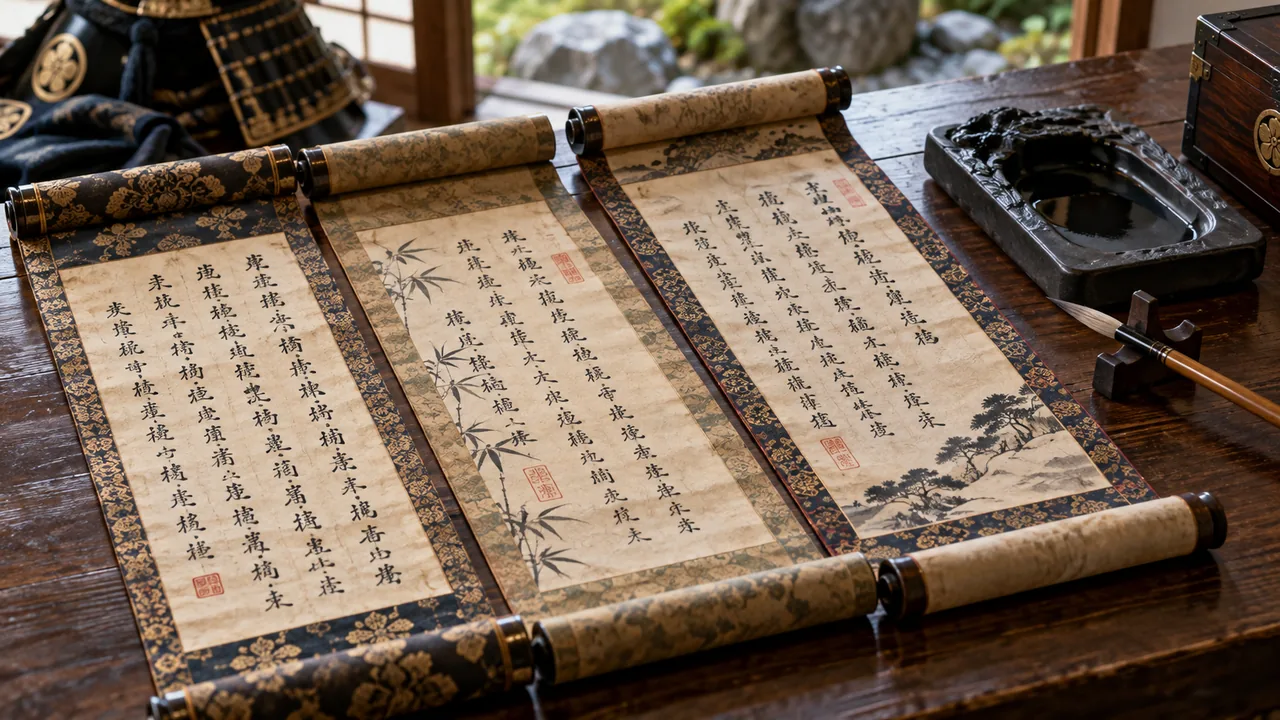
Most formal Japanese samurai names for men combine two kanji, each chosen for an admirable meaning such as loyalty, light, righteousness or prosperity. Read together, they express a hope for the bearer rather than a sentence. Below you will find real male given names with their characters and meanings, the most common building blocks, and the family habits that shaped how names were chosen.
How Samurai Given Names Are Built
The formal personal name of a samurai man, the name he received at his coming of age, was usually two characters long. Oda Nobunaga's given name is 信長: 信 (trust, faith) and 長 (long, also chief or leader). Japanese order puts the family name first, so Oda is the family and Nobunaga the person.
Three features make these names different from English ones:
- Meanings stack rather than combine. "Trust" plus "long" is not meant to become a single idea such as "long trust." Each character contributes a quality.
- Readings can be special. Names often use nanori, readings reserved for personal names. In Kusunoki Masashige (正成), the second character usually means "become" and is commonly read nari, but here it is read shige.
- Characters carry family history. A character might be inherited from a father, shared among brothers, or granted by a lord. Some names make most sense once you know whose name they echo.
These formal names were also not what most people called a samurai day to day. That is a story of its own, told in how samurai names actually worked. Here we focus on the formal names and what their characters say.
Samurai Names With Meanings
Each of these is the real given name of a well-known warrior. The meanings given are the standard meanings of the individual characters.
| Name | Kanji | Character meanings | Famous bearer |
|---|---|---|---|
| Nobunaga | 信長 | Trust, faith + long, chief | Oda Nobunaga |
| Hideyoshi | 秀吉 | Excellent, outstanding + good fortune | Toyotomi Hideyoshi |
| Ieyasu | 家康 | House, family + peace, ease | Tokugawa Ieyasu |
| Yoritomo | 頼朝 | Rely, trust + morning, also court | Minamoto no Yoritomo |
| Yoshitsune | 義経 | Righteousness + pass through, warp thread | Minamoto no Yoshitsune |
| Kiyomori | 清盛 | Pure, clear + prosper, flourish | Taira no Kiyomori |
| Masashige | 正成 | Correct, upright + become, accomplish | Kusunoki Masashige |
| Takauji | 尊氏 | Revered + clan, family | Ashikaga Takauji |
| Tokimune | 時宗 | Time + principal, origin | Hojo Tokimune |
| Motonari | 元就 | Origin, beginning + settle, accomplish | Mori Motonari |
| Mitsuhide | 光秀 | Light + excellent | Akechi Mitsuhide |
| Tadakatsu | 忠勝 | Loyalty + victory | Honda Tadakatsu |
| Naomasa | 直政 | Straight, honest + government, rule | Ii Naomasa |
| Kiyomasa | 清正 | Pure, clear + correct, upright | Kato Kiyomasa |
| Yoshimoto | 義元 | Righteousness + origin | Imagawa Yoshimoto |
| Toshiie | 利家 | Benefit, advantage + house | Maeda Toshiie |
| Kagekatsu | 景勝 | View, scenery + victory | Uesugi Kagekatsu |
| Kanetsugu | 兼続 | Combine, at the same time + continue | Naoe Kanetsugu |
| Takatora | 高虎 | High, tall + tiger | Todo Takatora |
| Yoshihiro | 義弘 | Righteousness + broad, wide | Shimazu Yoshihiro |
| Munenori | 宗矩 | Principal, origin + carpenter's square, standard | Yagyu Munenori |
| Nobushige | 信繁 | Trust, faith + thriving, luxuriant | Sanada Nobushige |
A couple of these are worth a closer look. Sanada Nobushige is better known today as Sanada Yukimura, but Nobushige is the name found in documents from his lifetime; Yukimura appears in later accounts and became the popular name. Munenori's second character, 矩, originally meant a carpenter's square, the tool used to draw true right angles, and by extension a rule or standard. For the head of a sword school who taught the shogun, it is a fitting choice.
The Most Common Building Blocks
Look at enough samurai names and the same characters keep appearing. They tend to express virtues, good fortune, strength or continuity of the family. Here are some of the most frequent, with the reading they usually take in names.
| Kanji | Name reading | Meaning |
|---|---|---|
| 義 | yoshi | Righteousness, duty |
| 信 | nobu | Trust, faith, sincerity |
| 忠 | tada | Loyalty |
| 正 | masa | Correct, upright |
| 光 | mitsu | Light |
| 康 | yasu | Peace, ease, health |
| 秀 | hide | Excellent, outstanding |
| 勝 | katsu | Victory |
| 盛 | mori | Prosper, flourish |
| 重 | shige | Heavy, weighty, serious |
| 輝 | teru | Shine, sparkle |
| 元 | moto | Origin, beginning |
These characters could go in either position. 秀 starts Hideyoshi but ends Mitsuhide, and 勝 starts Katsuyori but ends Tadakatsu. Position did not change the meaning, though families sometimes had habits about where a shared character went.
Family Characters and Granted Characters
Many names make more sense as part of a family pattern. The Hojo regents of the Kamakura shogunate repeatedly used 時 (time): Tokimasa, Yoshitoki, Yasutoki, Tokiyori and Tokimune all carry it. The Ashikaga shoguns favored 義 (righteousness), from Yoshimitsu and Yoshimasa to Yoshiteru and Yoshiaki, the last Ashikaga shogun. A shared character like this, passed along a line, is called a toorimoji.
The Minamoto show how these links can run through a family tree. Minamoto no Yoritomo and his half brother Yoshitsune were sons of Minamoto no Yoshitomo (義朝). Yoritomo's name repeats his father's second character, 朝, while Yoshitsune's repeats the first, 義. Further back, their ancestors Minamoto no Yoriyoshi (頼義) and his son Yoshiie (義家) used the same pair of characters, 頼 and 義, that would keep reappearing in the line. Once you notice this, a name like Yoritomo reads less like a random pair of good words and more like a family signature.
A character could also be a gift. A lord might grant a retainer or ally one character of his own name, an honor that publicly tied the two together. The most famous case involves Ashikaga Takauji. His name was first written 高氏, with 高 (high). After he helped Emperor Go-Daigo overthrow the Kamakura shogunate in 1333, he was allowed to use 尊 (revered), a character from the emperor's own personal name, and became 尊氏. The sound stayed the same, Takauji, but the meaning was lifted from "high" to "revered." Our article on reading kanji in samurai names goes further into granted and generational characters.
Tip: If you are naming a family of characters in fiction, give a father and his sons one shared character. It is historically grounded, and it quietly tells readers who belongs to which house.
Birth Order and Everyday Names
Alongside the formal name, men used everyday names, and many of them simply counted sons. These are among the most recognizable Japanese male names of all:
- Taro (太郎): "great son," the eldest
- Jiro (次郎): "next son," the second
- Saburo (三郎): "third son"
- Shiro (四郎): "fourth son"
- Goro (五郎): "fifth son"
The character 郎 means "son" or "young man." Prefixes adjusted these names, as in Kotaro (小太郎, "little Taro"). Other everyday names came from old court offices, like the endings -emon and -bei, or from the rank of assistant official, -suke. A man might be known all his life as a Saburo or a Hyoe while his two-character formal name appeared mostly on documents and in histories.
Same Sound, Different Meaning
Because Japanese has many characters that share a reading, a name heard aloud does not tell you its meaning. The name element yoshi, for example, can be written with many characters, including:
- 義 righteousness, as in Yoshitsune
- 吉 good fortune, as in Hideyoshi
- 良 good
- 善 virtuous
- 芳 fragrant
The same is true of masa, which appears as 正 (correct) in Masashige and 政 (government) in Naomasa. This is why a romaji name alone is never quite finished. When you choose a name, choose its kanji too, or you have only chosen a sound.
Choosing a Name With Meaning
Start with the qualities you want the name to carry, then look for two characters that express them and read naturally together. Check the reading, since name readings can surprise you, and decide whether the character should echo a family member or a lord. If you would like a head start, the samurai name generator shows each character's meaning alongside the name, so you can compare options quickly. Pair your given name with a family name from our guide to samurai clan names, and you will have a name that holds up to a close look.
Frequently Asked Questions
What does a samurai name usually mean?
A formal samurai given name normally combines two kanji, each chosen for a good meaning such as loyalty, righteousness, light or prosperity. The result is an aspiration or a pair of qualities rather than a phrase to translate word for word.
Why do samurai names use unusual readings of kanji?
Japanese names often use nanori, special readings reserved for names. For example, the character for 'become' is read shige in Kusunoki Masashige, even though it is rarely read that way in ordinary words. This is why the same kanji can sound different in a name than in a dictionary.
Did samurai brothers share part of their names?
Often, yes. Many families passed down a shared character across generations or between relatives, such as the Hojo regents' use of the character for 'time.' A lord could also grant one character from his own name to a retainer as an honor.

Written by the Samurai Names Editorial Team
We research samurai history, Japanese names and kanji, and check every name against standard dictionaries. Read our editorial policy or contact us with corrections.