How Samurai Names Actually Worked: Childhood Names to Buddhist Names
A samurai could have five or more names in one lifetime. Here is how childhood names, imina, common names and Buddhist names fit together, with real examples.
A samurai did not have one name for life. He usually had a childhood name, a formal adult name received at his coming of age, a common name used in daily life, and often a Buddhist name later on, plus a new surname if he was adopted or rose in rank. Understanding these layers explains why the same person can appear under several different names in history books.
One Person, Many Names
Here are the main kinds of names a samurai man might carry. Not everyone had all of them, and customs shifted over the centuries, but the pattern held broadly from the medieval period through the end of the Edo period in the 1860s.
| Name type | Japanese | What it was |
|---|---|---|
| Childhood name | yomyo 幼名 | The name used from birth until coming of age |
| Formal personal name | imina 諱 | The adult name received at genpuku, such as Nobunaga |
| Common name | tsusho 通称 | The name used in daily life, often a birth-order name or a court title |
| Buddhist name | homyo 法名 | Taken on entering religious life, sometimes while still active as a lord |
| Posthumous name | kaimyo 戒名 | A Buddhist name given after death |
On top of these sat the family name. Japanese order puts it first, so in Oda Nobunaga, Oda is the family and Nobunaga the formal personal name. Family names could change too, as you will see below.
Childhood Names
Boys of warrior families received a childhood name at birth. These names often used hopeful or protective elements. Two endings were especially common: -maru (丸), and -chiyo (千代), meaning "a thousand generations," a wish for a long life and a lasting house. Tokugawa Ieyasu was Takechiyo (竹千代) as a boy, and Uesugi Kenshin was Torachiyo (虎千代). Oda Nobunaga's childhood name was Kipposhi (吉法師).
Some families reused the same childhood name for heirs across generations, so a childhood name could quietly announce that a boy was the intended successor. Takechiyo, for example, was later used for heirs of the Tokugawa house.
Genpuku: Coming of Age and a New Name
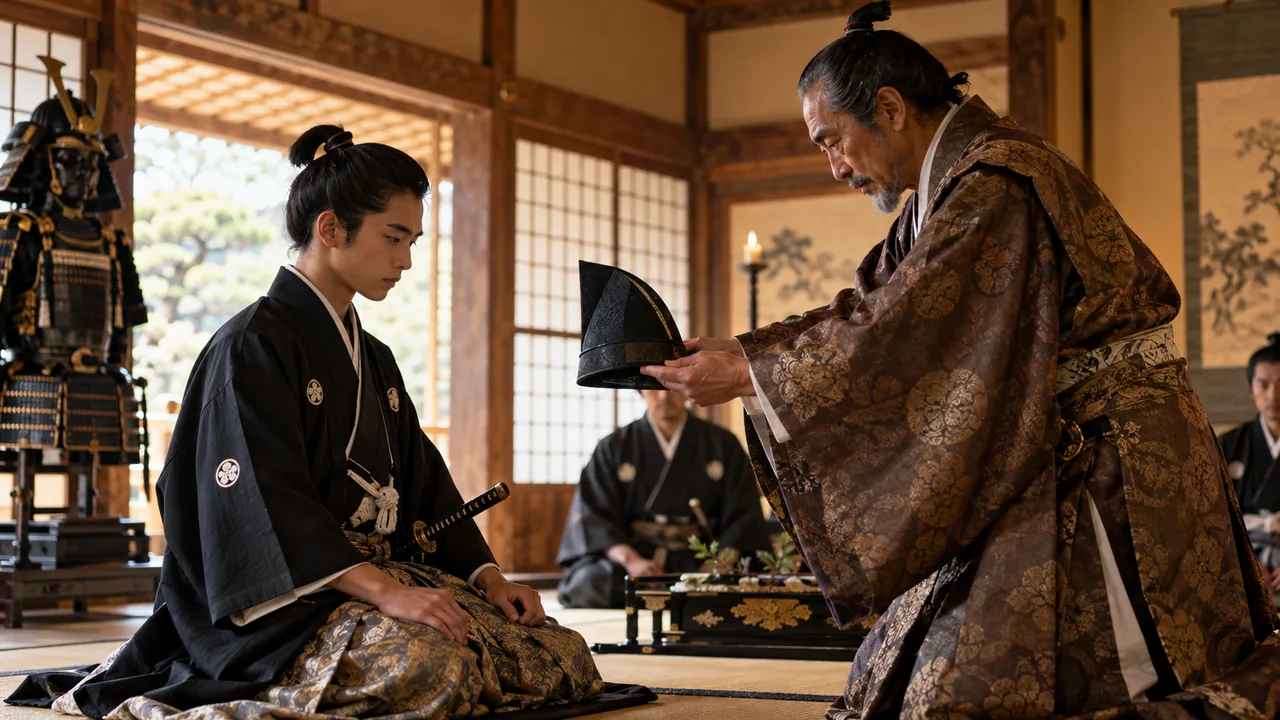
The turning point was genpuku (元服), the coming of age ceremony, usually held somewhere between the early and mid teens. The boy's hair was dressed in adult style and he received an eboshi, the tall cap worn by adult men. A senior sponsor, known as the eboshi-oya or "cap parent," placed it on his head and often played a role in choosing his new name.
At genpuku the boy received his imina, the formal two-character name. Very often one of the two characters was a gift. A powerful lord might grant a character from his own name, which honored the young man and openly placed him within the lord's network of allies. The Japanese term for such a granted character is henki, and our article on reading kanji in samurai names looks at how to spot one. The sponsor relationship did not end with the ceremony, either. A cap parent was expected to stay a patron and protector, so a young warrior's new name could tell everyone at court or in the castle exactly whose man he was. This practice explains a great deal: many names in the Sengoku period make sense only once you know which overlord stood behind them.
Imina and Tsusho: Formal Names and Everyday Names
The word imina is related to imu, "to avoid," and that tells you how it was treated. Calling a man by his formal personal name to his face was considered rude, much as addressing a superior by his first name might be in some cultures today. Instead, people used his tsusho, or common name.
Tsusho came in several forms. Many were birth-order names such as Saburo, "third son," or longer variations of them. Toyotomi Hideyoshi, early in his career, was known as Kinoshita Tokichiro. Others were names taken from old court offices, a practice often called hyakkan-na. Oda Nobunaga styled himself Kazusa no Suke, using the title of an official of Kazusa Province, though he held no real post there. Kira Yoshinaka, the official at the center of the story of the forty-seven ronin, is widely known as Kira Kozuke no Suke, after a court title.
So in his own lifetime, a man might rarely hear his formal name spoken at all. It appeared on documents, letters and genealogies, which is why histories today use it, while the people around him used something else entirely. Our article on samurai titles and ranks explains more about these court titles.
Tip: If you are writing samurai characters, let them address each other by common names or titles, and keep the formal name for documents, narration or moments of deliberate intimacy or insult. It is a small detail that makes dialogue feel authentic.
Buddhist Names
Many samurai took Buddhist vows later in life without giving up power. A man who shaved his head and took vows while remaining in the world was often called a nyudo, "one who has entered the way," and he took a Buddhist name. Several of the most famous names in samurai history are in fact Buddhist names. Takeda Shingen's formal name was Harunobu (晴信); Shingen (信玄) is the Buddhist name he took around 1559, and it is the one history remembers.
After death, a person received a kaimyo, a posthumous Buddhist name written on memorial tablets. This custom continues in Japan today. Kaimyo are usually long and formal, so they rarely became the names people used, but they are part of the full record of a life.
Case Study: Tokugawa Ieyasu
Ieyasu's names trace his rise from hostage to shogun almost step by step.
| Stage | Name | What changed |
|---|---|---|
| Birth, 1543 | Takechiyo 竹千代 | Childhood name, "bamboo" and "a thousand generations" |
| Genpuku | Matsudaira Motonobu 元信 | Coming of age while a hostage of the Imagawa; the character 元 came from his overlord, Imagawa Yoshimoto |
| Shortly after | Matsudaira Motoyasu 元康 | A new second character, usually linked to his grandfather Kiyoyasu |
| 1563 | Matsudaira Ieyasu 家康 | After breaking with the Imagawa, he dropped their character |
| 1566 | Tokugawa Ieyasu 徳川家康 | A new family name, adopted with court approval |
| Deified, 1617 | Tosho Daigongen 東照大権現 | Deified title, "Great Avatar Illuminating the East" |
Every change tells part of the story. The character from Yoshimoto marked dependence on the Imagawa. Dropping it after Yoshimoto's death at Okehazama in 1560 signaled independence. The new family name Tokugawa supported a claim to distinguished ancestry, and the divine title after his death placed the founder of the shogunate above ordinary rulers.
Case Study: Uesugi Kenshin
The warlord known as the Dragon of Echigo was not born an Uesugi and was not called Kenshin until late in life.
- Torachiyo (虎千代): his childhood name, born in 1530 into the Nagao family.
- Nagao Kagetora (長尾景虎): his name after coming of age.
- Uesugi Masatora (上杉政虎): in 1561 he was adopted by Uesugi Norimasa, taking the Uesugi name and the character 政 from Norimasa's name.
- Uesugi Terutora (上杉輝虎): soon after, he received 輝 from the shogun Ashikaga Yoshiteru.
- Uesugi Kenshin (上杉謙信): the Buddhist name he took around 1570, meaning "humility" and "trust."
Notice that the tiger, 虎, survived from Torachiyo through every formal name until he became Kenshin. Granted characters changed around it, but that one element stayed his own. Family names could shift just as dramatically: Hideyoshi went from Kinoshita to Hashiba, and was then granted the new name Toyotomi by the imperial court in 1586. The difference between those kinds of names is covered in our guide to samurai clan names.
Using Name History Today
All of this ended with the Meiji reforms of the 1870s, which registered every person under a single family name and a single given name. Before then, a samurai's names worked more like a career record than a fixed label. For readers, the lesson is to expect the same person under different names depending on the source and the year. For writers and players, it is an opportunity: a character who earns a new name, or loses one, has a story built in. If you want a starting point, the samurai name generator gives you a formal name with kanji and meanings, and you can decide what that character was called as a child, what his friends called him, and what he might be called at the end.
Frequently Asked Questions
What is the difference between imina and tsusho?
The imina was a samurai's formal personal name, such as Nobunaga or Ieyasu, and it was considered impolite to use it to his face. The tsusho was the common name used in daily life, such as Tokichiro or Saburo, or a title borrowed from a court office.
Why did samurai change their names so often?
A samurai received a new name at his coming of age ceremony, and later changes could mark a new alliance, adoption into another family, an honor granted by a lord, or entry into Buddhist life. Each name recorded a step in his career and relationships.
What was Tokugawa Ieyasu's original name?
His childhood name was Takechiyo, and he was born into the Matsudaira family. He later used the names Motonobu and Motoyasu before becoming Ieyasu in 1563, and he adopted the surname Tokugawa in 1566.

Written by the Samurai Names Editorial Team
We research samurai history, Japanese names and kanji, and check every name against standard dictionaries. Read our editorial policy or contact us with corrections.