Japanese Warrior Names Beyond the Samurai: Words, Types and Names
Bushi, mononofu, tsuwamono, musha: the Japanese words for warrior, and the foot soldiers, warrior monks and shinobi who fought alongside the samurai.
Japanese warrior names cover far more than the samurai. The language has several words for warrior, from bushi and musha to the older mononofu and tsuwamono, and Japan's battlefields were also crowded with foot soldiers, armed monks and covert agents who were named in their own ways. Here is what each word means, who these fighters were, and what their names tended to look like.
The Japanese Words for Warrior
Each of these words has its own shade of meaning, and choosing the right one can set the tone for a title, a character or a team name.
| Word | Kanji | Literal sense | Usage |
|---|---|---|---|
| Samurai | 侍 | "One who serves" | A warrior in service to a lord; later the hereditary warrior class |
| Bushi | 武士 | "Martial" + "gentleman" | The formal, general word for a warrior |
| Buke | 武家 | "Martial" + "house" | Warrior families as a group, in contrast to the court nobility |
| Musha | 武者 | "Martial" + "person" | A warrior, especially a fighting man in armor |
| Tsuwamono | 兵 | "Soldier, warrior" | An old native word, often with a sense of a seasoned fighter |
| Mononofu | 武士 | Ancient native word for warrior | Poetic and old-fashioned; often written like bushi |
| Kengo | 剣豪 | "Sword" + "great, mighty" | A master swordsman |
| Kensei | 剣聖 | "Sword" + "saint, sage" | A title of honor for a legendary swordsman |
The last two are honors rather than ranks. Kengo can describe any outstanding swordsman, while kensei is usually reserved for a few legendary masters of the sixteenth century, such as Kamiizumi Nobutsuna, founder of the Shinkage school, and Tsukahara Bokuden. Neither word was ever part of a person's name, so treat them as descriptions or epithets.
Samurai, Bushi and the Older Words
Samurai comes from the verb saburau, "to serve" or "to attend." In its earliest use it meant someone who waited on a noble, and only over time did it come to mean a warrior serving a lord and then the whole hereditary warrior class. Bushi is the more formal word. It is the term found in compounds such as bushido, "the way of the warrior," and it suits writing that wants a measured, historical tone.
Musha appears in useful phrases of its own. Musha shugyo (武者修行) is a warrior's training journey, the wandering in search of opponents and teachers that is attached to swordsmen like Miyamoto Musashi. The word onna-musha, "woman warrior," uses the same root, and our guide to female samurai names tells the stories of those women.
The older words feel different again. Tsuwamono has a weathered quality, and it appears in one of Japan's best-known poems. Visiting Hiraizumi, where Minamoto no Yoshitsune met his end, Matsuo Basho wrote:
夏草や兵どもが夢の跡
Natsukusa ya / tsuwamonodomo ga / yume no ato
Summer grasses: all that remains of warriors' dreams.
Mononofu is older still, a native word that appears in classical poetry. Because it was written with the same characters as bushi, it carries a romantic, archaic air. Either word makes a strong title for a story or a guild.
Ashigaru: The Foot Soldiers
Ashigaru (足軽) means "light of foot." These were the common foot soldiers who made up a growing share of armies from the Onin War of the late fifteenth century onward. They carried spears, bows and, after firearms arrived in Japan in 1543, matchlock guns, and the great Sengoku battles depended on them as much as on mounted samurai.
Their names reflected their status. Many ashigaru came from farming or village backgrounds, and outside the warrior elite surnames were not officially used, so records often identify them by a given name alone, sometimes with a village or unit. In the Edo period ashigaru sat on the lowest rung of the warrior hierarchy; in some domains they counted as samurai and in others they did not. A realistic ashigaru name is therefore short and plain, an everyday name like Tokichi or Gonbei, rather than a lordly two-character formal name. Gonbei was so typical of ordinary men that the phrase nanashi no Gonbei, "Gonbei with no name," is still the Japanese equivalent of John Doe.
Ashigaru could rise, though. The most famous example is Toyotomi Hideyoshi, who began in humble service under Oda Nobunaga and ended as ruler of Japan, collecting new names at every step.
Sohei: The Warrior Monks
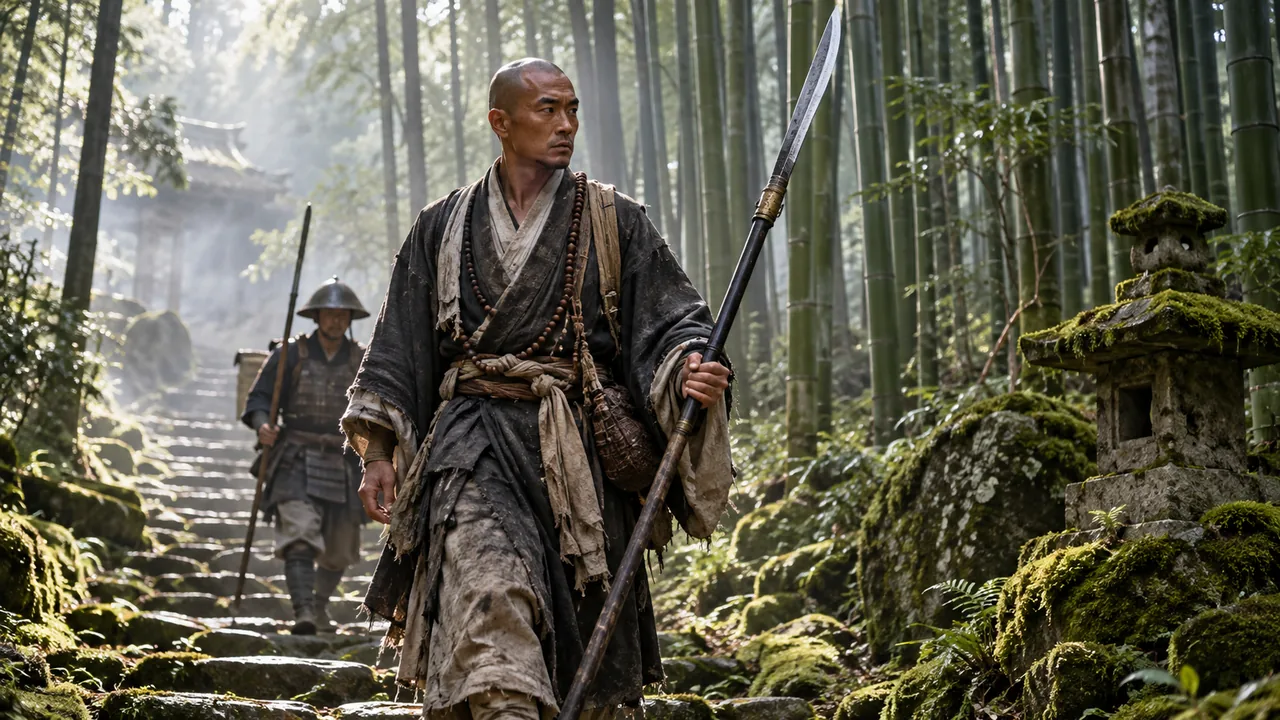
Sohei (僧兵) combines "monk" and "soldier." The great temples of the Heian and medieval periods, above all Enryakuji on Mount Hiei near Kyoto and Kofukuji in Nara, kept armed forces of monks and temple men to defend their estates and press their demands on the court. In a classic form of protest, the monks of Kofukuji marched on the capital carrying the sacred branch of the Kasuga Shrine, while those of Enryakuji carried the portable shrines of the Hie Shrine, daring anyone to strike at objects that belonged to the gods. The word sohei itself is mostly a later label; in their own time they were usually just called monks of a particular temple or mountain.
The Tale of the Heike attributes a famous complaint to the retired emperor Shirakawa: the waters of the Kamo River, the roll of the dice and the monks of the mountain were the three things he could not control. The power of Mount Hiei lasted until Oda Nobunaga destroyed Enryakuji in 1571.
Warrior monks were named as monks. They had Buddhist names, and many were known by a name ending in -bo (坊), a word for a monk's lodging. The best-known example is Musashibo Benkei (武蔵坊弁慶), the giant companion of Yoshitsune in legend. Benkei's story is largely the stuff of tales and plays, but his name follows the real pattern.
Tip: For a warrior monk character, pair a place or temple word with -bo and a two-character Buddhist name, in the Musashibo Benkei pattern. It reads as authentically monastic rather than as a samurai name with a robe thrown over it.
Shinobi: The Covert Agents
The historical word was usually shinobi (忍び), from a verb meaning both "to endure" and "to act in secret." The reading ninja (忍者), with the same first character, became the standard popular term only in the twentieth century. Two regions became especially associated with these skills: Iga (伊賀) and Koka (甲賀), neighboring areas in what are now Mie and Shiga Prefectures.
Real shinobi were spies, scouts and raiders rather than black-clad assassins, and many were themselves warriors of local families. The best-known names belong to leaders. Hattori Hanzo was a Tokugawa commander of Iga descent, and Hanzomon, a gate of Edo Castle, still carries his name. Fuma Kotaro (風魔小太郎) was the name used by successive leaders of a band serving the Hojo of Odawara; Fuma combines "wind" and "demon." That inherited, almost title-like use of a single name is a nice detail to borrow. You can read more about Hanzo in our article on famous samurai names.
Ronin, Goshi and Other Warriors
- Ronin (浪人): "wave person," a samurai without a lord, drifting like a wave. Our guide to ronin names covers them in depth.
- Hatamoto (旗本): "under the banner," direct retainers of the Tokugawa shogun in the Edo period.
- Goshi (郷士): rural samurai who lived on and often farmed their land. Sakamoto Ryoma came from a goshi family of Tosa.
- Ji-zamurai (地侍): local landholding warriors of the Sengoku period, somewhere between village leaders and samurai.
These categories overlapped more than tidy lists suggest. A ji-zamurai might serve as a shinobi for a regional lord, a samurai who lost his master became a ronin overnight, and a ronin could be hired back into service and regain his rank. For naming, that fluidity is useful: a character's name can carry traces of where he started, even after his status has changed.
Naming a Warrior by Type
The kind of warrior should shape the name. A lord or senior samurai suits a family name and a two-character formal name. An ashigaru suits a short everyday name. A warrior monk takes a Buddhist name, often with -bo. A shinobi might be best known by a single code-like name or one inherited with a role. Our samurai name generator has separate Shinobi and Warrior Monk styles alongside the classic samurai ones, so you can match the name to the fighter from the start. For a full cast, the Japanese Warrior Name Generator builds names by role, from daimyo to ashigaru.
Frequently Asked Questions
What is the difference between samurai and bushi?
Both refer to the warrior class, and today they are often used interchangeably. Samurai comes from a verb meaning to serve, so it originally stressed service to a lord, while bushi is a broader formal term for a warrior, written with the characters for martial and gentleman.
What is an old Japanese word for warrior?
Mononofu and tsuwamono are both old native words for warrior. Mononofu often appears in poetry and is commonly written with the same characters as bushi, while tsuwamono is famously used in Matsuo Basho's haiku about the summer grasses at Hiraizumi.
Were ninja called ninja in their own time?
The more common historical word was shinobi, from a verb meaning to endure or to act in secret. The reading ninja, using the same first character, became the popular term in the twentieth century.

Written by the Samurai Names Editorial Team
We research samurai history, Japanese names and kanji, and check every name against standard dictionaries. Read our editorial policy or contact us with corrections.