Samurai Honorifics: Dono, Sama, Gozen, Hime and the "no" in Names
What dono, sama, gozen and hime really meant in samurai Japan, why it is Minamoto no Yoritomo but never Tokugawa no Ieyasu, and how to use honorifics well.
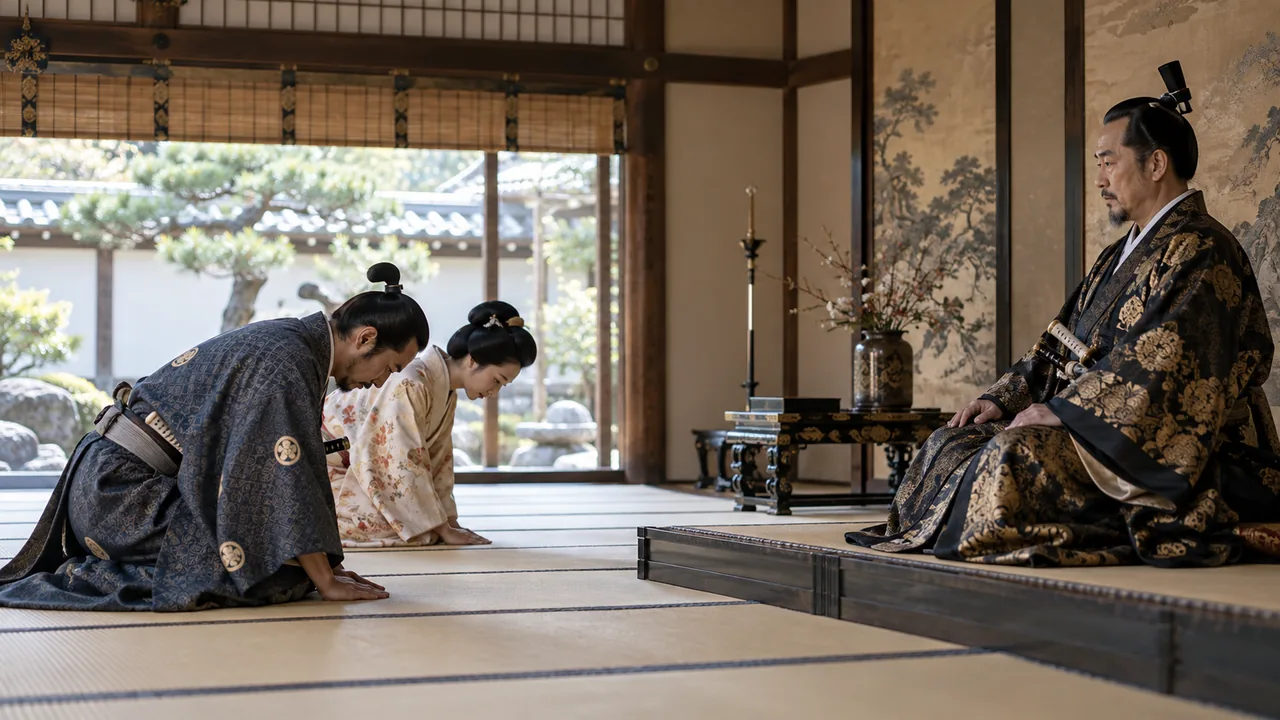
Samurai honorifics like dono, sama, gozen and hime were forms of respect added to a name, not part of the name itself. The little word no in Minamoto no Yoritomo is different again: it links an ancient clan name to a personal name. This guide explains what each one meant, who used it, and how to use them correctly if you are naming a character or reading history.
Honorifics Are Not Names
The single most useful rule: an honorific describes how you address or refer to someone, and it changes with the speaker and the situation. A retainer, a rival and a chronicler might all refer to the same lord differently. The underlying name does not change.
That is why a character called "Kenji-sama" in a story has the name Kenji, not Kenji-sama, and why the same warrior can be "Takeda-dono" in one letter and "Shingen-ko" in a later history. Our guide to common samurai name mistakes lists "using an honorific as the name" as one of the most frequent errors.
The "no" in Minamoto no Yoritomo
源頼朝 is written with no extra character between surname and given name, yet it is read Minamoto no Yoritomo. The no (の) is the Japanese particle for "of," and it is traditionally inserted after ancient clan names called uji (氏).
- Uji with no: Minamoto no Yoritomo, Taira no Kiyomori, Fujiwara no Michinaga. These are the great clan names granted or recognized by the imperial court.
- Myoji without no: Ashikaga Takauji, Takeda Shingen, Tokugawa Ieyasu. These are family surnames, usually taken from a place where a branch of a larger clan settled.
The two systems coexisted. The Ashikaga were a branch of the Minamoto, so Takauji was Ashikaga by surname and Minamoto by clan. Tokugawa Ieyasu claimed Minamoto descent and could be written formally as 源家康, Minamoto no Ieyasu. In practice, historians use the no form for the Heian and early Kamakura figures known by their clan names, and the plain surname form for later warriors.
The same particle appears in court titles (Echizen no Kami, "governor of Echizen") and in epithets (Kai no Tora, "Tiger of Kai"). In all three cases it simply means "of." For the families themselves, read our guide to samurai clan names.
Tip: Never write "Tokugawa no Ieyasu" or "Takeda no Shingen." If you invent a surname for a character in a later era, leave out the no. Save it for ancient clan names or for titles and epithets.
Dono and Sama: Addressing People of Standing
Dono (殿)
The character means a great hall or mansion, and as an honorific it originally pointed to a person by naming their residence, a polite way of not saying their name directly. Shoguns were called by their seat of power: Kamakura-dono for the Kamakura shogun and Muromachi-dono for the Ashikaga shogun in Kyoto.
Over time dono became a standard honorific in letters and official documents, attached to a surname, a personal name or a title. In the Edo period it was generally considered less exalted than sama, which made it suitable for peers or for a superior writing to a subordinate. Today it survives mostly on certificates and formal written notices.
The same character read tono means "lord," and 殿様, tono-sama, was the usual way to speak of a daimyo.
Sama (様)
Sama literally means "manner" or "appearance," and became a high honorific placed after names and titles. In the Edo period the shogun was spoken of as Ue-sama (上様), "the one above." The everyday modern honorific san developed from sama, which is why it can feel like a softened version of the same word.
Ko, Kubo and Other Lordly Forms
Ko (公) means "lord" or "prince" and is used after the names of high nobles and great historical figures, often in a commemorative way: "Nobunaga-ko," "Kenshin-ko." You will see it on shrine signs and in local histories that honor a famous lord.
Kubo (公方) referred to the shogun in the Muromachi period, and also to the Ashikaga deputies in eastern Japan known as the Kanto kubo.
Titles could also become nicknames. Tokugawa Mitsukuni, lord of Mito, is famous as Mito Komon. Komon (黄門) is a Chinese style name for the court office of chunagon, middle counselor, which he held. For more court titles like these, see our guide to samurai titles and ranks.
Nyudo and Buddhist forms
When a samurai took Buddhist vows without fully leaving the world, he could be called nyudo (入道), "one who has entered the Way," a lay monk. The word worked like a respectful label attached to a name or title. In The Tale of the Heike, Taira no Kiyomori is repeatedly called Nyudo Shokoku, the lay monk chancellor, and the great swordsmith Masamune is traditionally known as Goro Nyudo Masamune. Famous Buddhist names such as Shingen and Kenshin are a different thing: they are names, not honorifics, and our article on how samurai names worked explains how they were taken.
Gozen, Hime and No Kata: Honorifics for Women
Women of the samurai class are often known to history mainly through honorifics, partly because their personal names were recorded less consistently than men's.
| Honorific | Kanji | Meaning | Historical example |
|---|---|---|---|
| Gozen | 御前 | "Honorable presence" | Tomoe Gozen, Shizuka Gozen |
| Hime | 姫 | Lady, princess; daughter of a noble house | Senhime 千姫 |
| No Kata | の方 | "The honorable person"; used for noble wives and consorts | Oichi no Kata お市の方 |
| Tsubone | 局 | Title of a senior lady in a court or castle household | Kasuga no Tsubone 春日局 |
Gozen
御前 combines the honorific prefix 御 with 前, "front" or "presence." It was attached to women of status: Tomoe Gozen, the warrior who fought alongside Kiso Yoshinaka, and Shizuka Gozen, the dancer loved by Minamoto no Yoshitsune. Interestingly, the casual modern word for "you," omae, is written with the same characters and was once respectful. Our article on female samurai names tells Tomoe's story in full.
Hime
Hime (姫) was used for daughters of noble and daimyo houses. Senhime, a granddaughter of Tokugawa Ieyasu, was married to Toyotomi Hideyori and survived the fall of Osaka Castle in 1615. Oda Nobunaga's wife is popularly called No-hime (濃姫), "the lady from Mino," a name that refers to her home province rather than her personal name.
The o- prefix and no Kata
Women's names in the samurai era were often short and written in kana, and the polite prefix o (お) was added in speech: Oichi, Nobunaga's sister, became Oichi no Kata as the wife of a lord. Maeda Toshiie's wife is remembered simply as Matsu.
What About -ko?
The ending -ko (子), "child," is not an honorific in the same sense, but it is often mistaken for one. In the Heian court it appeared in the formal names of noblewomen, such as Empress Shoshi, 彰子. In ancient times it could even appear in men's names: the envoy Ono no Imoko (小野妹子), sent to Sui dynasty China in the early seventh century, was a man. The -ko ending only became the standard pattern for ordinary girls' names in the modern era, so an Edo period samurai daughter named "Hanako" would be an anachronism.
Using Honorifics in Your Names
Some practical guidelines:
- Keep the name and the honorific separate. Decide the name first, then choose how different characters address that person.
- Match honorific to relationship. A retainer speaking to his lord uses something respectful like tono or sama; a lord writing to a vassal might use dono.
- Use no only where it belongs: with ancient clan names, titles and epithets.
- For women, consider a historical honorific such as gozen or no Kata rather than a modern -ko name for pre-modern settings.
Honorifics are also a cheap and effective way to show relationships on the page. A young retainer who calls his lord "tono" in public and something warmer in private, or a rival who pointedly drops the honorific altogether, tells the reader a great deal without a word of explanation. The name stays fixed; the honorific does the emotional work.
If you need a base name to attach honorifics to, our samurai name generator produces names in classic, daimyo and onna-musha styles, each with kanji and meanings. Add the honorific yourself, and let it shift as your characters' relationships change.
Frequently Asked Questions
What does dono mean after a samurai's name?
Dono (殿) is an honorific meaning roughly "lord" or "sir," originally from a word for a great hall or residence. In the samurai era it was widely used in letters and documents to address or refer to people of standing. Today it survives mainly in formal written documents.
Why is it Minamoto no Yoritomo but Tokugawa Ieyasu?
Minamoto is an ancient clan name, or uji, and those are traditionally joined to the personal name with the particle no, meaning "of." Tokugawa is a family surname, or myoji, which is written directly before the personal name without no. Ieyasu formally claimed Minamoto descent, so in formal documents he could be written as Minamoto no Ieyasu.
Is gozen a name or a title?
Gozen (御前) is an honorific, not a personal name. It was attached to the names of women of status, as in Tomoe Gozen and Shizuka Gozen. Using it in a character's name is fine as long as you treat it as a respectful form of address rather than part of her given name.

Written by the Samurai Names Editorial Team
We research samurai history, Japanese names and kanji, and check every name against standard dictionaries. Read our editorial policy or contact us with corrections.