Japanese Surnames That Sound Like Samurai Clans, and Why They Do
Mountains, rice fields, rivers and bridges: how Japanese surnames were built from the land, why the Meiji laws matter, and which names carry real warrior history.
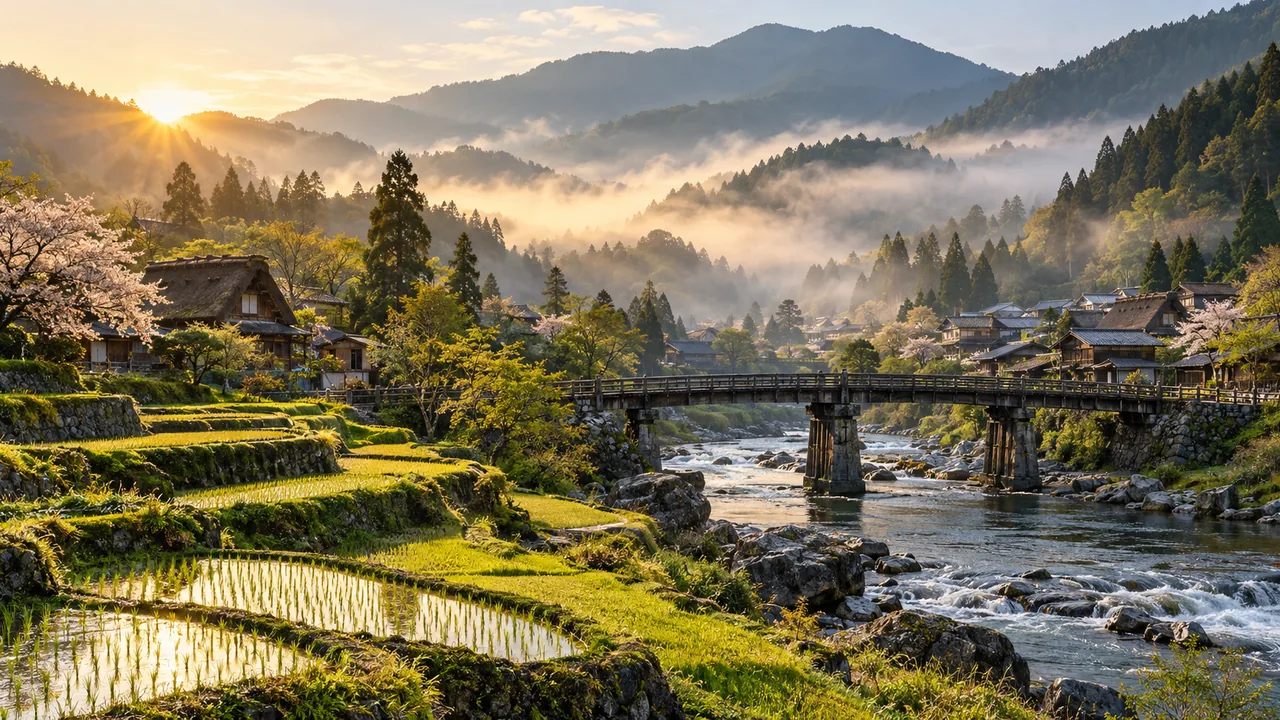
Many Japanese surnames sound like samurai clans because they were built the same way: from the land. Mountains, rice fields, rivers, pines and bridges appear in famous warrior names and in everyday modern ones alike. This guide explains how those surnames are put together, why the Meiji surname laws of 1870 and 1875 changed who had one, and which names carry genuine warrior history.
Why So Many Surnames Sound Like Samurai
Medieval warrior families very often took their surnames from the land they lived on or controlled. The Ashikaga were named after Ashikaga in Shimotsuke Province, the Nitta after Nitta in Kozuke, the Hojo of the Kamakura shogunate after Hojo in Izu, and the Matsudaira, the family Tokugawa Ieyasu was born into, after a village in Mikawa. A surname was, in effect, an address that became a lineage.
Place names, in turn, describe landscape. So when a later family took its name from where it lived, it ended up with the same building blocks the warrior houses had used. That is why a modern office worker named Yamada and a medieval lord with a landscape surname can sound equally "samurai" to English speakers. To Japanese ears, of course, most of these names simply sound normal.
It also helps to know the difference between two older words for family name. The ancient clan name (uji) such as Minamoto or Fujiwara was different from the household surname (myoji, 苗字) that branches of those clans later adopted. Our post on samurai clan names covers that distinction and the great families in detail. Here we focus on surnames as most Japanese people have them today.
Building Blocks From the Land
Most common Japanese surnames are two kanji long, and many end with a character describing a landscape feature. Learn a dozen of these and you can read the rough meaning of hundreds of surnames.
| Element | Kanji | Meaning | Example surnames |
|---|---|---|---|
| -yama | 山 | mountain | Maruyama, Akiyama |
| -kawa / -gawa | 川 | river | Ishikawa, Ogawa |
| -ta / -da | 田 | rice field | Okada, Yamada |
| -moto | 本 | base, origin | Yamamoto, Hashimoto |
| -mura | 村 | village | Nakamura, Kimura |
| -no | 野 | field, plain | Ono, Hoshino |
| -hara / -wara | 原 | plain, meadow | Ishihara, Fujiwara |
| -shima / -jima | 島 | island | Kojima, Nakajima |
| -saki / -zaki | 崎 | cape, promontory | Iwasaki, Okazaki |
| -sawa / -zawa | 沢 | marsh, mountain stream | Kurosawa, Ozawa |
| -oka | 岡 | hill | Fukuoka, Morioka |
| -mori | 森 | forest | Omori, Kanamori |
The voiced forms (-gawa, -da, -jima, -zaki) come from a sound change called rendaku, where the first consonant of the second part becomes voiced. It is not fully predictable. Ishikawa stays unvoiced while Ogawa voices, and the same written name 中島 is read Nakajima by some families and Nakashima by others. When in doubt, follow how a particular family actually reads its name.
The Meiji Surname Laws of 1870 and 1875
Under the Tokugawa shogunate, the official right to use a surname in public, together with the right to wear swords, was a mark of status. Samurai had it, and certain commoners were granted it as a privilege, a combination known as myoji taito (苗字帯刀), "surname and sword." Many villagers and townspeople did have family names they used among themselves, but they could not use them officially.
The Meiji government, which abolished the old status system, changed this in two steps. In 1870 it issued an order permitting commoners to use surnames. Take-up was slow, so in 1875 a second order made having a surname compulsory for everyone. Some families registered names they had quietly used for generations. Others chose new ones, often from local landscape features, the name of their village or a nearby landmark.
The practical result is important for anyone looking for a "samurai surname." A great many modern surnames were formally registered only in the 1870s, and a surname by itself is not evidence that a family descends from samurai.
Tip: If you want a name that suggests warrior ancestry in fiction, pair an ordinary landscape surname with period-appropriate given names and titles. The context does more work than the surname alone.
Common Surnames and Their Literal Meanings
The surnames below are among the most familiar in Japan. The meanings given are literal readings of the characters, not stories about any particular family.
| Surname | Kanji | Written with the characters for |
|---|---|---|
| Sato | 佐藤 | "assist" and "wisteria" |
| Suzuki | 鈴木 | "bell" and "tree" |
| Takahashi | 高橋 | "high" and "bridge" |
| Tanaka | 田中 | "rice field" and "middle" |
| Watanabe | 渡辺 | "crossing" and "vicinity" |
| Yamamoto | 山本 | "mountain" and "base" |
| Nakamura | 中村 | "middle" and "village" |
| Kobayashi | 小林 | "small" and "woods" |
| Inoue | 井上 | "well" and "above" |
| Matsumoto | 松本 | "pine" and "base" |
The character 藤 (wisteria) in names like Sato, Kato, Ito, Saito and Endo is traditionally linked to the Fujiwara, the powerful court clan whose name contains it. These derivations are traditional explanations, and individual families with these names may have entirely different histories.
Surnames With Real Warrior History
Some surnames are ordinary today but are attached to famous warriors, which gives them a special ring for anyone who knows the stories.
- Kumagai (熊谷): written with the characters for "bear" and "valley." Kumagai Naozane fought for the Minamoto in the Genpei War, and the tale of his killing the young Taira no Atsumori, and later becoming a monk, is one of the best known episodes of The Tale of the Heike.
- Kusunoki (楠木): written with the characters for "camphor tree" and "tree." Kusunoki Masashige fought for Emperor Go-Daigo and died at the Battle of Minatogawa in 1336, becoming a lasting model of loyalty.
- Sanada (真田): written with "true" and "rice field," named after the Sanada area of Shinano Province. Sanada Nobushige, better known as Yukimura, is remembered for his stand at Osaka.
- Hattori (服部): a name usually traced to an ancient guild of weavers. Hattori Hanzo Masanari served Tokugawa Ieyasu and was linked with warriors from Iga.
- Watanabe (渡辺): associated with Watanabe no Tsuna, a Heian period warrior remembered in legend as a retainer of Minamoto no Yorimitsu who cut off a demon's arm.
Using one of these names for a character immediately invites comparison with the historical figure, which can be a strength or a distraction depending on your aim.
Building a Convincing Surname
If you want an invented surname that sounds right, combine one descriptive element with one landscape element, and keep it to two kanji. Colors, sizes, directions, trees and stones make good first halves: 黒 (black), 白 (white), 大 (great), 小 (small), 北 (north), 松 (pine), 岩 (rock). Add a landscape ending from the table above and you get names such as Kurosawa, Shiraishi, Kitagawa or Iwasaki, all of which are real surnames.
That last point is worth stressing: nearly any natural combination already exists as a surname somewhere in Japan. Rather than worrying about inventing something unique, aim for something plausible. A surname that combines a dragon and a sword reads as fantasy, while a black marsh or a white stone reads as a real family. For more on what to avoid, see our guide to common samurai name mistakes.
A delightful exception proves the rule. The rare surname 小鳥遊, written "where little birds play," is read Takanashi, "no hawks," because small birds can only play freely where there are no hawks. Wordplay like this is unusual, which is exactly why people enjoy it.
Choosing a Surname With Samurai Character
Decide first what the surname needs to do. For historical fiction, a plain landscape name paired with period-correct given names, explained in our post on how samurai names actually worked, is usually the most believable option. For a game or a pen name, you can lean into stronger imagery such as rock, black or wild river. Either way, check the reading and the kanji together, because the meaning lives in the characters.
If you would like a starting list, our samurai name generator pairs surnames with given names and shows the kanji and literal meaning for each part, which makes it easy to compare a few options before you decide.
Frequently Asked Questions
Did only samurai have surnames in Japan?
During the Edo period, the official right to use a surname in public was largely restricted to samurai and certain privileged commoners, although many ordinary families had surnames they used informally. In 1870 the Meiji government allowed all commoners to take surnames, and in 1875 it made having one mandatory.
Is Tanaka a samurai name?
Tanaka is one of the most common surnames in Japan and is not tied to any single samurai clan. It is written with the characters for rice field and middle, so it sounds ordinary to Japanese ears, much like a common English surname does to English speakers.
What does the ending -moto mean in Japanese surnames?
It is usually written 本, meaning base or origin. In surnames such as Yamamoto, Matsumoto and Hashimoto it suggests a family living at the foot of a mountain, by a pine tree or near a bridge.

Written by the Samurai Names Editorial Team
We research samurai history, Japanese names and kanji, and check every name against standard dictionaries. Read our editorial policy or contact us with corrections.