Common Samurai Name Mistakes and How to Avoid Every One
Fake kanji, backwards name order, -ko on a man, -san as part of a name: the errors that make made-up samurai names sound wrong, and how to fix each one.
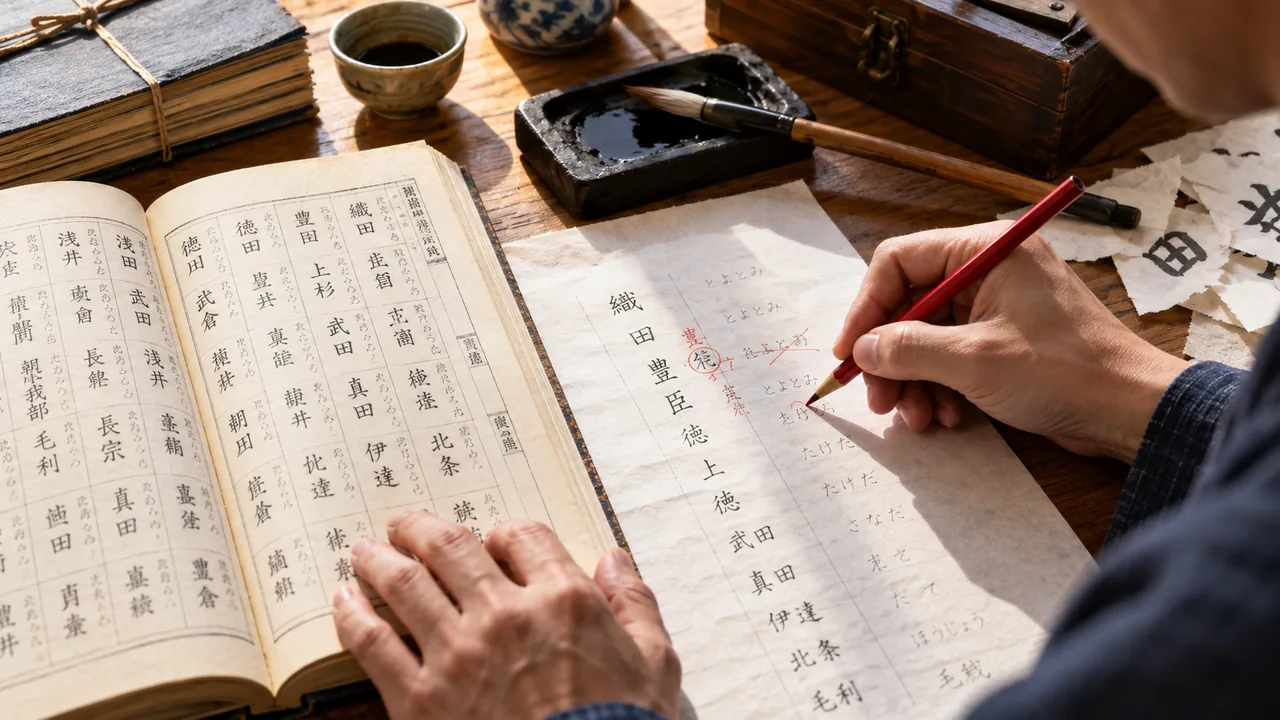
Most samurai name mistakes fall into a handful of patterns: kanji that do not form a real name, Western name order, endings used for the wrong gender, honorifics or titles treated as names, and syllables borrowed from Chinese or Korean. Each one is easy to fix once you know what to look for. Here are the most common errors we see in made-up samurai names, why they are wrong, and what to do instead.
Fake Kanji and "Alphabet" Charts
The single most widespread mistake is the kanji alphabet: a chart that assigns one kanji to each English letter so that "Mike" becomes four random characters. These charts are inventions. Japanese does not spell foreign names letter by letter in kanji, and the result means nothing to a Japanese reader. Foreign names are normally written in katakana, the script used for loanwords.
A subtler version of the same error is choosing kanji only by meaning. Picking "dragon" plus "fire" plus "sword" because each sounds cool produces a string of characters, not a name. Real Japanese given names use particular characters with particular readings, many of them special name readings called nanori. A combination has to be readable as a name, not just as a list of meanings.
How to fix it:
- Start from an existing name pattern, such as two-character male names like 正信 (Masanobu) or 忠勝 (Tadakatsu), rather than from a meaning you want.
- Check that every character has a reading that is actually used in names.
- If you are going to tattoo, engrave or publish the characters, have a fluent reader confirm them first.
Our guide to reading kanji in samurai names explains how name readings work in more depth.
Putting the Given Name First
Japanese names place the family name first and the given name second. Oda is the family and Nobunaga the individual, so "Oda Nobunaga" is correct and "Nobunaga Oda" is the Western rearrangement. For modern people, English writing has long been inconsistent, and in 2019 the Japanese government announced it would prefer the surname-first order in official English documents. For historical figures, surname first is the standard in scholarship.
The mistake is not using one order or the other; it is mixing them. A story that introduces "Takeda Shingen" in chapter one and "Shingen Takeda" in chapter three confuses readers and looks careless. Pick surname first for historical settings, and stay consistent.
Misusing the -ko Ending
The ending -ko, usually written 子 and meaning "child," is strongly associated with women's names: Hanako, Yoshiko, Michiko. Adding it to a male warrior's name, as in "Kenshinko" or "Ryuko the swordsman," immediately sounds wrong to anyone who speaks Japanese.
History has a famous twist here. In ancient times the character could appear in men's names, and the court envoy sent to Sui China in 607, Ono no Imoko (小野妹子), was a man. That is an early exception, not a model for a samurai. Among women, too, -ko was long associated with aristocratic families and became widespread among ordinary women mainly in the modern era, so it is not automatically a good fit for a peasant girl in a sixteenth-century story either.
Be careful not to confuse 子 with other syllables pronounced "ko." The ending in Hachiko, the famous Akita, is 公, an affectionate honorific meaning "lord," not the feminine ending.
Tip: If you are unsure whether an ending is masculine or feminine, look at how it is written. The same sound can be a girl's name ending, a nickname suffix or part of an entirely different word depending on the kanji.
Treating -san, -sama or -dono as Part of the Name
Honorifics attach to a name; they are not part of it. "Tanaka-san" is like saying "Mr. Tanaka" or "Ms. Tanaka." A character introduced as "Kenji-san" in the narrator's voice, or a username such as "SamuraiSan," reads oddly to Japanese speakers. Japanese speakers also never use -san about themselves, so a character saying "I am Tanaka-san" sounds either childish or comic.
The historical honorifics follow the same rule. Dono and sama show respect when addressing or referring to others. As part of a name, gozen is best known for women of standing, as with Tomoe Gozen, so attaching it to a male character's name will usually read as a mistake. Our post on samurai honorifics covers which ones fit which situations.
Using Titles as Names
Shogun, daimyo, sensei, ronin and ninja are all positions or descriptions, not names. A character called "Shogun" is like an English character named "President." Worse, titles are often attached to the wrong people. "Shogun Takeda" is a common slip: Takeda Shingen was a powerful daimyo, but he never held the title of shogun.
The same goes for "Lord" used as a first name or "Ronin" used as a surname. A ronin was a samurai without a master, and the word describes his situation. Sensei simply means teacher and is used for doctors and schoolteachers as well as sword instructors, so it is a form of address, never a name. Ninja, too, is a description; historical sources more often used the word shinobi for these agents. If you want a name that hints at it, our post on samurai titles and ranks explains how real titles were used alongside names.
Mixing in Chinese or Korean Sounds
Japanese, Chinese and Korean all use or have used Chinese characters, but they pronounce them very differently. The character for dragon, 龍, is ryu or tatsu in Japanese, long in Mandarin and yong in Korean. A "Japanese samurai" named Long or Yong has wandered into the wrong language. The same applies to surnames: Li, Wang, Kim and Park are Chinese or Korean, not Japanese.
There is a quick test you can apply. In Hepburn romanization of native Japanese words:
- every syllable ends in a vowel or in "n"
- the letters l, q, v and x do not appear
- consonants do not cluster, apart from double consonants such as the "kk" in Hokkaido and combinations such as "sh," "ch" and "ts"
A name like "Xiao Long" or "Kwang Ryu" fails immediately. That does not make Chinese or Korean names bad, only wrong for a Japanese samurai.
Misplaced "no" and Overstuffed Names
The particle no in names like Minamoto no Yoritomo belongs to ancient clan names. It does not go between a household surname and a given name, so "Oda no Nobunaga" and "Takeda no Shingen" are both wrong.
Another common habit is stacking every impressive element into one name: a surname, two given names, an epithet and a title at once. Real samurai did accumulate many names over a lifetime, but they used them one or two at a time depending on the situation. A clean surname plus given name, with an epithet used separately, sounds far more convincing.
A related problem is mixing elements from different centuries. A Heian-style clan name with "no," an Edo-style common name ending in -zaemon and a fashionable modern given name do not belong to the same person. If your setting has a clear period, keep every part of the name in that period.
Finally, watch out for using famous personal names as if they were generic. Musashi and Hanzo are tied so tightly to specific historical figures that a character with either name will be compared to them. That can be intentional, but it should not be an accident.
Checking Your Name Before You Use It
Before you settle on a name, run through a short checklist: real kanji with valid name readings, surname first, an ending that matches the character's gender, no honorifics or titles inside the name, Japanese sounds only, and "no" only where it belongs. Those six checks catch nearly every problem.
Our samurai name generator makes several of these checks quick, because every result shows the kanji, the meaning of each character and a syllable-by-syllable pronunciation, so you can see exactly what you are getting. You can read more about how we research and check names on our editorial standards page.
Frequently Asked Questions
Is it wrong to write a samurai name with the given name first?
It is not wrong in casual English, but it breaks the convention historians and Japanese sources use for historical figures, who are written surname first, as in Oda Nobunaga. For anything with a historical setting, surname first is the safer and more authentic choice.
Can a male samurai name end in -ko?
In modern Japanese, -ko written 子 is a feminine given-name ending, so it reads as a woman's name. There are rare ancient exceptions, such as the male envoy Ono no Imoko, but for a samurai character it is best avoided on male names.
Is -san part of a Japanese name?
No. San is an honorific added after a name when speaking to or about someone else, much like Mr. or Ms. It is never part of the name itself, and people do not use it about themselves.

Written by the Samurai Names Editorial Team
We research samurai history, Japanese names and kanji, and check every name against standard dictionaries. Read our editorial policy or contact us with corrections.