Kamon: Samurai Family Crests and How They Pair With Clan Names
What kamon are, how Japanese family crests are designed, the emblems of famous samurai clans, and how to match a crest to a clan name.
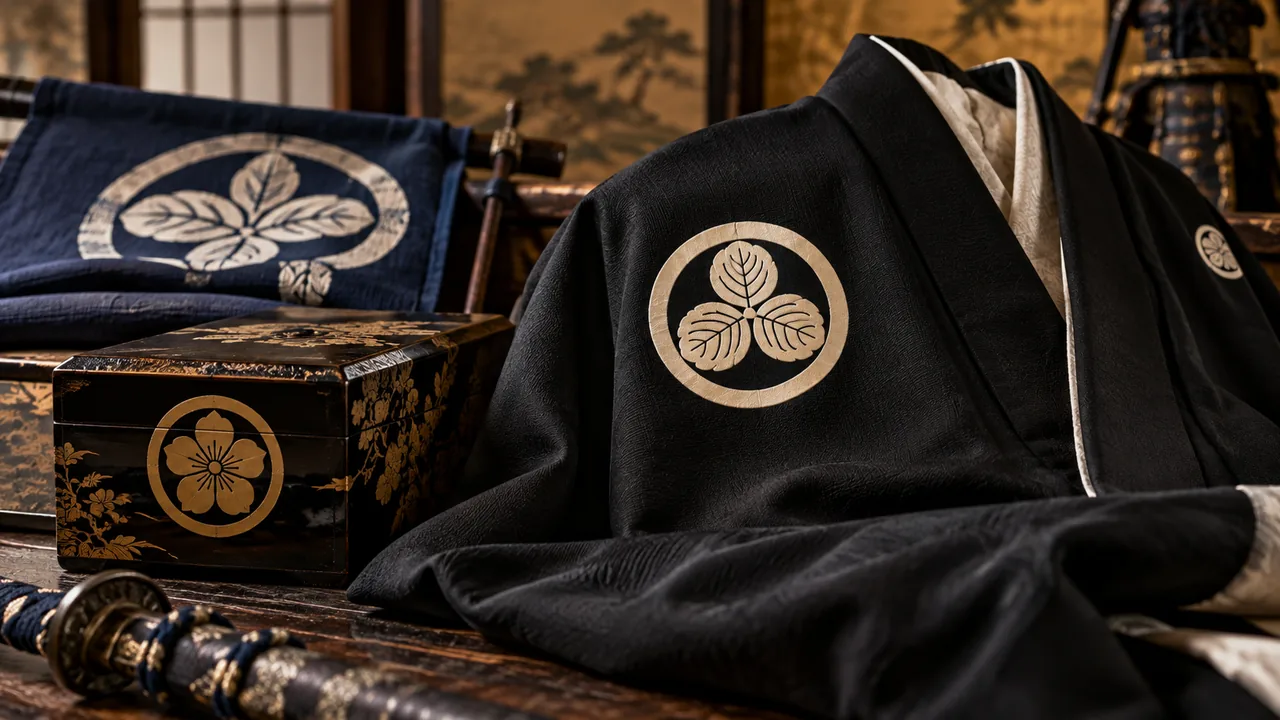
A kamon (家紋) is a Japanese family crest: a compact, usually circular emblem that identifies a household. Samurai clans painted them on battle flags, stitched them onto formal clothing and stamped them on lacquerware, and many of the same designs are still in use today. Here is how kamon work, what the best known clan crests look like, and how to pair a crest with a clan name so the two feel like they belong together.
What a Kamon Is
The word is written with the characters for "house" (家) and "crest" or "pattern" (紋). In conversation people often shorten it to mon. A kamon belongs to a family line rather than to one person, which makes it closer to a surname than to a personal signature. When a samurai wore his crest, he was announcing which house he belonged to.
Crests grew out of the Heian court, where aristocrats decorated their ox carts and garments with distinctive patterns that others could recognize at a glance. Warrior families took up the idea and gave it a very practical job: telling friend from enemy. By the long civil wars of the fifteenth and sixteenth centuries, crests appeared on tall banners (nobori), on the cloth curtains that screened a commander's field headquarters (jinmaku), and on the small flags many soldiers carried on their backs (sashimono).
Kamon differ from European heraldry in a few important ways. Japan had no heralds' college that granted and recorded designs, there were no fixed rules about colors, and a crest was normally drawn in a single color that could change from one object to the next. A family might use several crests, and a lord could reward a loyal retainer by granting him the right to use his own crest or a variation of it.
How Kamon Designs Are Built
Thousands of crest variations exist, but most of them are assembled from a fairly small set of ideas. The motif comes first. Plants are by far the largest group, followed by animals, objects, natural forms such as waves or clouds, geometric shapes, and written characters.
The motif is then modified with a handful of standard terms that also appear in the crest's name. Learning a few of them makes crest names much easier to read:
- Maru ni (丸に): "in a circle." Enclosing a motif in a ring is one of the most common variations, so maru ni takanoha is hawk feathers inside a circle.
- Mitsu (三つ): "three." The motif is repeated three times, as in mitsudomoe (三つ巴), three comma shapes swirling around a center, a design commonly seen at Hachiman shrines.
- Chigai (違い): "crossed." Two elements overlap, such as crossed hawk feathers or crossed arrows.
- Kagemon (陰紋): an outline version of a crest, drawn as thin lines instead of a solid shape. The solid version is called hinatamon (日向紋), the "sunny side" crest.
Because the system is modular, a family that split into branches could keep its core motif while changing the details. A circle added here, a leaf count changed there, and the branch had an emblem that was related to the main house yet distinct from it.
Famous Clan Crests at a Glance
The table below lists crests that are firmly tied to well known samurai families. Names are given surname first, the normal Japanese order.
| Clan | Crest | Kanji | What it shows |
|---|---|---|---|
| Tokugawa | Mitsuba aoi | 三つ葉葵 | Three aoi leaves in a circle; aoi is usually translated "hollyhock," though the plant is a wild ginger |
| Takeda | Takeda-bishi | 武田菱 | Four diamonds arranged into one larger diamond |
| Sanada | Rokumonsen | 六文銭 | Six coins in two rows |
| Shimazu | Maru ni juji | 丸に十字 | A cross inside a circle |
| Oda | Oda mokko | 織田木瓜 | A five-lobed flower-like shape |
| Hojo (Kamakura) | Mitsu uroko | 三つ鱗 | Three triangles representing scales |
| Mori | Ichimonji ni mitsuboshi | 一文字に三つ星 | The character for "one" above three dots, or stars |
| Akechi | Kikyo | 桔梗 | A bellflower |
| Maeda | Umebachi | 梅鉢 | A stylized plum blossom |
| Asano | Chigai takanoha | 違い鷹の羽 | Two crossed hawk feathers |
| Toyotomi | Go-shichi no kiri | 五七桐 | Paulownia leaves with flower stalks of five, seven and five blossoms |
A few of these carry well known traditions. The Sanada coins are usually explained as the fare for crossing the Sanzu River into the afterlife, a sign that the wearer was prepared to die in battle. The paulownia was an imperial emblem that was granted to powerful warriors, Toyotomi Hideyoshi among them, and a version of it still serves as an emblem of the Japanese government today. The Asano crest became famous through the story of the Ako ronin, whose lord was Asano Naganori. If you want the background on these families themselves, our guide to samurai clan names covers where they came from.
Crests Off the Battlefield
Most of the time a crest was not on a banner at all. It was on clothing, furniture and luggage. Formal kimono called montsuki (紋付) carry the family crest in set positions, and the most formal style has five: one on the back, one on the back of each sleeve and one on each side of the chest. This custom outlived the samurai class and is still part of formal Japanese dress.
Families often distinguished between a main crest, the jomon (定紋), and alternate crests, the kaemon (替紋). The main crest appeared on the most official occasions, while an alternate might be used on less formal items.
During the Edo period, crests spread well beyond the warrior class. Merchant houses put them on the curtains hung over shop entrances, kabuki actors had their own, and many ordinary families adopted one. Some designs remained protected, though. The shogunate restricted use of the Tokugawa hollyhock, and the early Meiji government limited use of the imperial chrysanthemum. Outside those exceptions, a crest was something almost anyone could have.
Tip: Because crests spread to every class during the Edo period, a family crest today says very little on its own about samurai ancestry. Treat it as a family emblem, not as proof of rank.
What Crest Symbols Mean, and What Nobody Knows
It is tempting to assign a neat meaning to every crest, and many websites do. The honest answer is that the origin of most family crests is not recorded. Families often chose a motif because it was attractive, because it echoed their name, because a lord granted it, or for reasons that have since been lost. Explanations written centuries later can be charming without being reliable.
Some links are solid, though. Wisteria (藤, fuji) crests are widely associated with families that claimed descent from the Fujiwara, whose name contains the same character. Name-based crests also occur: the Ii family, whose name begins with the character for a well (井), used a well-frame design called igeta among its crests. Plants with auspicious associations, such as pine, bamboo and plum, were popular for obvious reasons, and the symbolism of those motifs is explored in our post on symbols in samurai names.
When you read that a particular crest "means courage" or "means loyalty," it is worth asking whether that is a documented family tradition or a modern guess. For fiction and games that distinction matters less, but for anything presented as history it matters a lot.
Pairing a Crest With a Clan Name
If you are inventing a samurai house for a story, a tabletop campaign or simply for fun, the crest and the name should support each other. A few principles help.
Echo the name where you can
Many Japanese surnames are built from landscape and plant words, which gives you a natural starting point. A house written with the character for pine (松) could reasonably carry a pine crest. A name containing the character for wisteria suits a wisteria design. This mirrors real practice without copying any specific family.
Keep it to one motif
Real kamon are spare. One motif, perhaps enclosed in a circle or repeated three times, is far more convincing than a crest that combines a dragon, a sword and a cherry blossom. If you can describe the crest in four or five words, as in "three oak leaves in a ring," you are probably on the right track.
Avoid the protected and the famous
The hollyhock reads as Tokugawa and the chrysanthemum reads as imperial to anyone familiar with Japan. Likewise, the Takeda diamonds or the Sanada coins will make readers think of those families immediately. Use them only if you mean to invoke those houses.
Match the crest to the character of the house
A frontier clan of hard riders might use hawk feathers or arrows. A cultured house with court connections might prefer a flower. A family of temple patrons could use a tomoe. The crest is a small piece of worldbuilding, and it works best when it agrees with everything else you know about the family. Our guide to naming samurai characters in fiction goes further into keeping these details consistent.
Choosing a Crest That Fits
The simplest route is to start with the house name and let it suggest the emblem. The Clan House style in our samurai name generator does exactly that, offering a house name together with a kamon motif so you can see the pair side by side, and you can rerun it until a combination feels right. From there, decide whether the crest sits in a circle, whether the motif repeats, and whether the family has an alternate crest for less formal use.
Whatever you choose, keep the design restrained and the story behind it modest. The real crests that survived for centuries were rarely elaborate. They were clear, quick to recognize across a crowded field, and easy to stitch onto a sleeve, which is still the best test for a crest of your own.
Frequently Asked Questions
What is the difference between kamon and mon?
There is no real difference in everyday use. Mon means crest or emblem, and kamon adds the character for house, so it specifically means a family crest. Both words are used for the same circular designs.
Did every samurai family have a crest?
Crests were widespread among warrior households, and many families used more than one. Over the Edo period they also spread to merchants, artisans and actors, so a crest by itself does not prove samurai ancestry.
Can I use a famous clan crest for my own fictional clan?
You can, but readers who know Japanese history will connect it to the real family, especially the Tokugawa hollyhock or the imperial chrysanthemum. For an invented clan it is usually better to build a new crest from a common motif such as pine, wisteria, hawk feathers or a geometric shape.
Written by the Samurai Names Editorial Team
We research samurai history, Japanese names and kanji, and check every name against standard dictionaries. Read our editorial policy or contact us with corrections.