How to Use a Samurai Name Generator Well: A Practical Guide
Styles, themes, your own name as a seed, shortlisting and testing: a practical walkthrough for getting a samurai name you will actually keep.
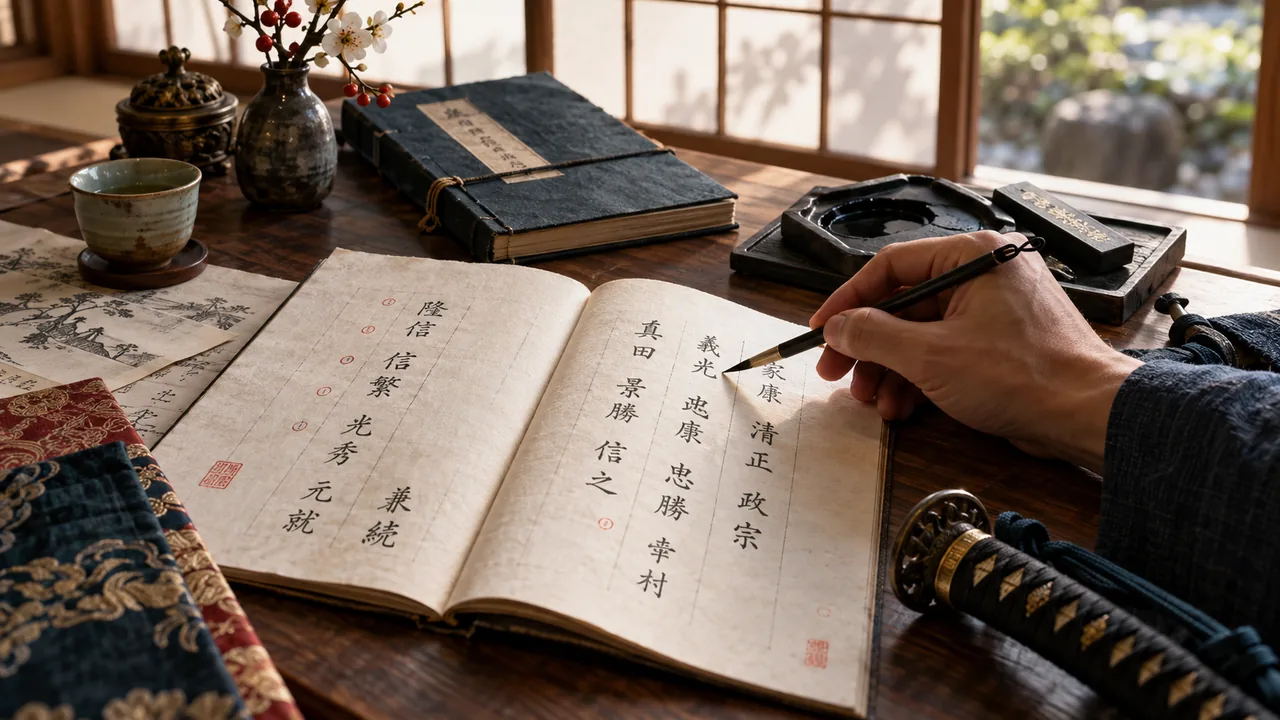
A samurai name generator works best when you know what the name needs to do. Pick the style that matches where the name will live, add a theme for the mood, generate a generous batch, then shortlist a few and test each one out loud and against its kanji meanings before you commit.
What Each Result Shows You
Every name our samurai name generator produces comes with more than a string of letters. You get the romaji (the name written in Latin letters), the kanji it is written with, a meaning for each character, and a syllable-by-syllable pronunciation guide. That extra detail is the whole point. A name that sounds great but carries a meaning you dislike is a name you will end up replacing a week later.
The tool runs entirely in your browser. It does not use AI, and nothing you type is sent anywhere, including your own name if you choose to enter it. Favorites are kept in your browser's storage, so they stay on the device you used. If you switch from a laptop to a phone, your saved list will not follow you, which is worth knowing before you build a long shortlist.
Names appear in Japanese order, with the family name first. In Takeda Shingen, Takeda is the family and Shingen is the personal name. Historians writing in English usually keep this order for premodern figures, and we recommend you do the same if your name will appear in a story or a profile set in old Japan. Whatever you choose, stay consistent.
Choosing the Right Style
The style setting changes how names are put together, not just which words appear. Here is a quick guide to the twelve styles and where each one tends to fit.
| Style | What you get | Works well for |
|---|---|---|
| Classic Samurai | A family name plus a period-style given name | Historical fiction, role-play characters |
| Daimyo Lord | Names with the weight of a ruling house | Rulers, faction leaders, villains with armies |
| Onna-musha | Names for female warriors | Women with a martial background |
| Ronin | A name plus an English epithet | Wanderers, mercenaries, lone heroes |
| Legendary Epithet | A creature paired with a province | Nicknames, titles, boss characters |
| Clan House | A house name with a kamon (family crest) | Factions, guilds, tabletop houses |
| Shinobi | Names suited to spies and infiltrators | Stealth characters and rogues |
| Warrior Monk | Names in the manner of the sohei, armed temple monks | Monastic or spiritual fighters |
| Sword Names | Blade names ending in -maru or -kiri | Weapons, heirlooms, ships |
| Dojo School | School names ending in -ryu | Martial arts schools and training halls |
| Anime Hero | Dramatic, modern-sounding names | Anime-inspired stories, fan characters |
| Gamer Tag | Short, punchy handles | Usernames and online profiles |
A few styles are modeled closely on real habits. The Legendary Epithet style follows the pattern of famous nicknames: Takeda Shingen was remembered as the Tiger of Kai, after the province he ruled (today's Yamanashi Prefecture), and his great rival Uesugi Kenshin as the Dragon of Echigo. The Sword Names style draws on how blades were actually named. The ending -maru appears on many celebrated swords, such as Kogarasumaru (小烏丸, "little crow"), while -kiri means "cutter," as in Higekiri (髭切, "beard cutter"). Dojo School names end in -ryu (流), a character meaning "flow" that came to mean a school or style of martial art.
If you are writing historical fiction, start with Classic Samurai or Daimyo Lord. Anime Hero and Gamer Tag are intentionally looser and more modern. That suits a username perfectly, but it can feel out of place in a novel set in 1580.
Themes and Gender Settings
Themes steer the meanings behind the kanji. You can choose from strength, virtue, nature, light and sky, or beasts and legends. Think of a theme as the emotional color of the name rather than a strict filter.
- Strength suits fighters and generals. Japanese names often express it with characters such as 剛 (strong, sturdy) or 武 (martial).
- Virtue leans on ideals the warrior class prized, like 義 (righteousness), 忠 (loyalty) and 誠 (sincerity).
- Nature brings in landscape and plants, such as 松 (pine) and 竹 (bamboo), which feel calm and grounded.
- Light and sky favors brightness and weather, for example 光 (light) and 月 (moon).
- Beasts and legends is the dramatic option, with creatures like 龍 (dragon) and 虎 (tiger).
The gender setting can be any, male or female. Historical naming did differ by gender. Men of the warrior class often carried formal two-character names, while many women were known by short names such as Matsu or Chiyo, sometimes with an honorific attached. If you want names for women warriors in particular, the Onna-musha style is the better starting point, and our guide to female samurai names explains the history behind them.
Using Your Own Name
Typing your name into the generator gives you a personal result that repeats: the same name, with the same settings, produces the same output every time. That makes it easy to come back to "your" samurai name later, or to compare results with friends.
It is worth being clear about what this is not. It is not a translation. Japanese has no standard equivalent for most English names, and a foreign name would normally be written phonetically in katakana, the script used for foreign words. Your name acts as a seed that picks from real Japanese name elements, so the result is a Japanese name chosen for you, not a version of your own.
The count option runs from 1 to 60. One name is fun for a quick answer. For anything you plan to keep, a larger batch is far more useful, because you will be choosing rather than settling.
Building a Shortlist
Good names are usually found by comparison. A simple process works well:
- Generate a batch of twenty or thirty with your chosen style and theme.
- Favorite anything that catches your eye on first read. Do not overthink it at this stage.
- Switch the theme, or try a neighboring style, and run another batch. A Classic Samurai name might look better beside Daimyo Lord results than you expected.
- Open your favorites and cut the list to three to five names.
- Print the list, or keep it open, and live with it for a day before choosing.
Tip: Read your shortlist at different sizes and in different contexts. A name that looks elegant in a character sheet may be awkward as a short gamer tag, and a punchy handle may feel thin as the name of a lord.
Testing a Name Before You Use It
Say it out loud
Japanese pronunciation is friendlier than it looks. The five vowels are short and pure (a as in "father," i as in "machine," u as in "flute," e as in "met," o as in "go"), and each syllable gets roughly equal time, without the heavy stress English puts on one syllable. Takeda is ta-ke-da, not "ta-KEE-da." Use the pronunciation guide on each result to break the name into syllables.
Some names contain long vowels that romaji often hides. Hojo is properly Hōjō, with both o sounds held a little longer, and Ryu is really Ryū. We write names without the long marks, as most English sources do, but saying the long vowels makes a name sound noticeably more natural.
Read the kanji meanings
Look at each character's meaning and then at the name as a whole. Japanese names are not sentences: two characters such as "pure" and "prosper" are an aspiration, not a phrase to translate word for word. Also note that names often use special name readings, called nanori, that differ from how the same kanji are read in everyday words. Our article on reading kanji in samurai names covers this in more depth.
Check the fit with your setting
Ask whether the name suits the world it will live in. A wandering swordsman, a ruling lord and a temple fighter would all be named differently, and samurai themselves changed names several times over a lifetime, as explained in how samurai names actually worked. Avoid using ranks as names, too: daimyo and shogun are titles, and -san is a polite form of address, not part of anyone's name. Our list of common samurai name mistakes covers more pitfalls like these.
Look it up before going public
Before you use a name for a published book, a brand or a public profile, search for it. Some combinations belong to famous historical figures or well-known fictional characters. That can be a nice homage if you intend it, and an awkward surprise if you do not.
Choosing Your Name
The best samurai name is one you understand. Choose a style for the context, a theme for the feeling, then compare several options side by side rather than taking the first result. Check that the kanji say something you are happy to carry, say the name aloud until it sounds natural, and make sure it fits the person, character or account behind it. When you are ready, open the name generator, run a full batch and start your shortlist.
Frequently Asked Questions
Does the samurai name generator translate my English name into Japanese?
No. Japanese has no fixed translation for English names; a foreign name would normally be written phonetically in katakana. When you enter your name, the generator uses it as a seed, so you get a personal result that repeats each time with the same settings, but it is not a translation.
Are the names from the generator real Japanese names?
They are built from real kanji with their standard meanings and follow common Japanese naming patterns, such as surname first. Some styles, like Anime Hero and Gamer Tag, are deliberately freer and more modern, so they suit usernames and fiction better than a strict historical setting.
Is anything I type sent to a server?
No. The generator runs entirely in your browser and does not use AI. Your favorites are stored in your own browser, so they stay on the device you used and are not shared with anyone.

Written by the Samurai Names Editorial Team
We research samurai history, Japanese names and kanji, and check every name against standard dictionaries. Read our editorial policy or contact us with corrections.